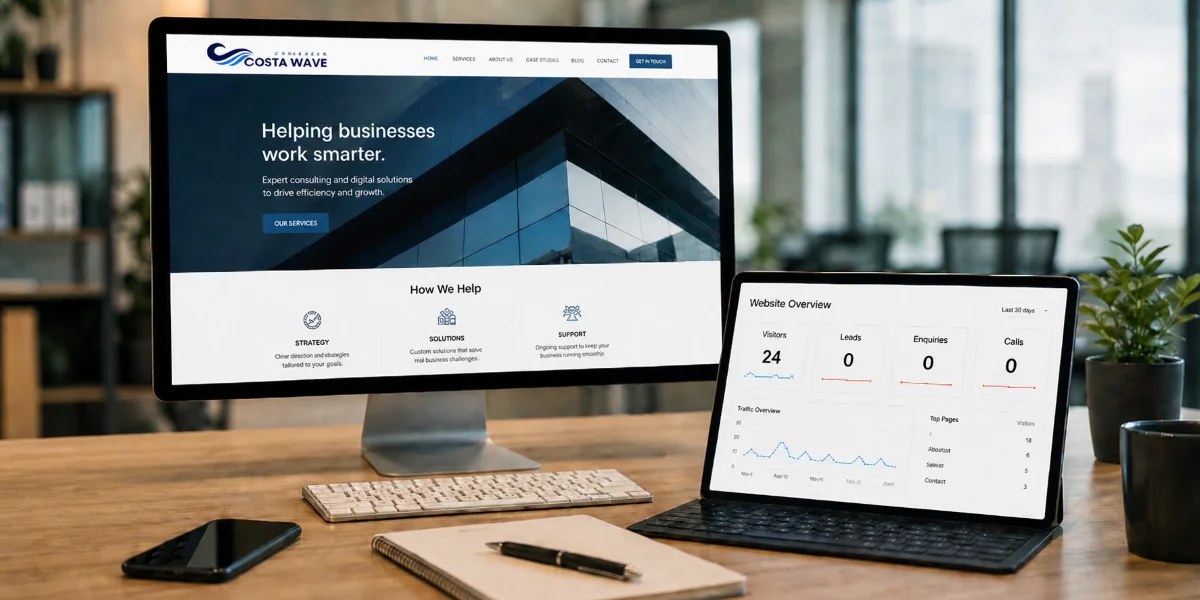
You have a website. It's live. And it does absolutely nothing for your business. No calls, no enquiries, no new clients. Here's what actually goes wrong, and where to start.
Why your website doesn't work (and what to do about it)
The technology behind a website is rarely the first reason it fails to generate enquiries. WordPress, a modern JavaScript stack or a website builder can all work well. Visibility, content, speed, usability and a clear next step usually matter more.
No calls. No enquiries. Just a page somewhere online, costing hosting fees, and doing nothing.
The frustrating part is that nobody told them why. The person who built it didn't mention it. The hosting company didn't bring it up. Visitors who quietly closed the tab didn't leave a note. So the website sits there, and eventually the owner assumes websites just don't work.
They do. Just not like this.
Nobody knows it exists
This is the one that comes up constantly, and it's almost always the last thing people consider.
A website does not receive visitors simply because it is online. Traffic can come from organic search, Google Business Profile, advertising, social media, referrals, email or direct visits. The right mix depends on the business and audience.
A lot of businesses on the Costa Blanca go live and wait. They assume Google picks it up automatically, that word spreads, that visitors somehow appear. But without Google Ads, a properly set-up Google Business Profile, local SEO, relevant content, referrals or other channels, it may take time to build sufficient traffic. Google Ads is one option, not a requirement.
If enquiries only arrive while you are advertising, examine both your traffic sources and what visitors do on the site. The problem may be reach, conversion or both.
Price does not tell the whole story
A low-cost website can be well built and an expensive website can disappoint. A smaller budget usually means a narrower scope, such as less custom work, fewer pages or less guidance. Judge what was actually delivered rather than inferring quality from price alone.
A template is not a problem by itself either. A well implemented template can be fast, clear and effective. Problems arise when design and content are barely adapted to the business, audience and goals.
People feel this when they land on a site, even when they can't explain it. A rushed website sends a message about the business behind it. The business might be great. The website just isn't saying so.
Here's a full breakdown of what websites actually cost, and where the real differences are.
The hosting is slowing it down
Cheap hosting is one of those savings that feels smart until it isn't.
Slow servers produce slow websites. Research by Portent shows that load time can affect conversion. That does not mean every budget hosting plan is slow. Hosting is one factor alongside images, caching, theme, scripts, database and application code. Measure the actual site before assigning the cause.
And speed is only part of it. No SSL certificate means visitors get a browser security warning before they even reach your homepage. Most leave immediately. They don't know what SSL is. They just know something felt off.
HTTPS is a basic requirement. Backups and monitoring are strongly recommended, but the appropriate frequency depends on the type of site. A store with daily orders has different needs from a simple brochure site.
The content is about you, not your visitor
There's nothing wrong with mentioning you've been in business since 2001 or that it's a family operation. But that's rarely why someone came to your site.
People arrive with a question or a problem. The content needs to meet them there. What do you do? Who's it for? What should they do next?
Google's E-E-A-T framework (Experience, Expertise, Authoritativeness, Trustworthiness) is a quality framework from Google's guidelines. It does not say content must always begin with the visitor's problem. Content is stronger when it is clear, useful, trustworthy and aligned with search intent.
And if there's no clear call to action anywhere, no button, no phone number, no "contact us," most visitors leave without doing a thing. They weren't uninterested. Nobody showed them where to go.
There's no SEO
Search engines need structure to understand what a site is about and who to show it to.
Page titles, clear heading structure, crawlable internal links, indexability and a sitemap can help search engines understand a site. Meta descriptions mainly support snippets and alt text is primarily for accessibility. Missing one element does not automatically make a site invisible, but a weak technical and content foundation can limit discoverability. the same reasons most businesses on the Costa Blanca don't appear in Google.
AI search experiences also use information from the web. A strong SEO foundation helps, but there is no fixed relationship where Bing or Google positions automatically determine whether ChatGPT, Google AI Overviews or other systems cite your page.
The technical side is a mess
A 17MB hero image. A page that jumps around while it loads. No caching, no lazy loading, uncompressed files.
Each one is a small problem. Together they produce a site that loads slowly and ranks poorly. Google has treated page speed as a ranking factor since 2010. Performance and Core Web Vitals can contribute to page experience, but speed is not the only or dominant ranking factor. Fix technical problems primarily because they genuinely hinder visitors or crawling.
It was never designed to do anything
A website built to "be a website" does exactly that: it exists. It doesn't generate leads, book appointments, answer questions, or make the phone ring. Nobody built it to do those things.
A website should work at 2am on a Sunday when nobody's available. It should answer the questions clients would otherwise call to ask. It should be the most consistent introduction your business has.
If none of that was part of the brief, it won't happen on its own.
Where to start
Look at the basics first. Not the design. The fundamentals.
Is the site fast? Does it have SSL? Is it properly indexed by Google? Are page titles and meta descriptions written for actual people? Is the content about your visitor's problem or about your business? Is there a call to action on every page? Is your Google Business Profile set up and consistent?
If most of those answers are no, or "I'm not sure," the website isn't broken. It was never finished.
Most of these things are fixable. And fixing them properly is what turns a site that does nothing into one that actually works.
Send me your URL on WhatsApp and I'll give you an honest picture of where things stand.
Read more: