AI can help with website content. It can also damage it. Here's the honest breakdown: when it works, when it hurts your SEO and your credibility, and how to use it without making your website sound like every other business online.
Should you use AI to write your website content?
Short answer: sometimes. With conditions.
The longer answer matters more, because how you use AI for content is everything. It saves time and gets you past the blank page. It also produces content that sounds like every other business's website if you let it run without a strong edit.
Here's the honest breakdown.
What AI is actually good for
Overcoming the blank page. If you know what you want to say but can't get started, AI is useful for producing a rough first draft you can then shape into something that actually sounds like you.
Generating structure. "Give me an outline for a page about my villa cleaning service in Javea" is a legitimate use. You get a skeleton. You fill it with real content.
FAQs and supporting content. AI can help create a first draft of common questions, service descriptions and other material where you can verify the facts. Legal documents such as terms and conditions are different and require current, appropriate legal review.
Meta descriptions. Short, structured, specific: AI writes decent meta descriptions with a clear prompt.
Where it goes wrong
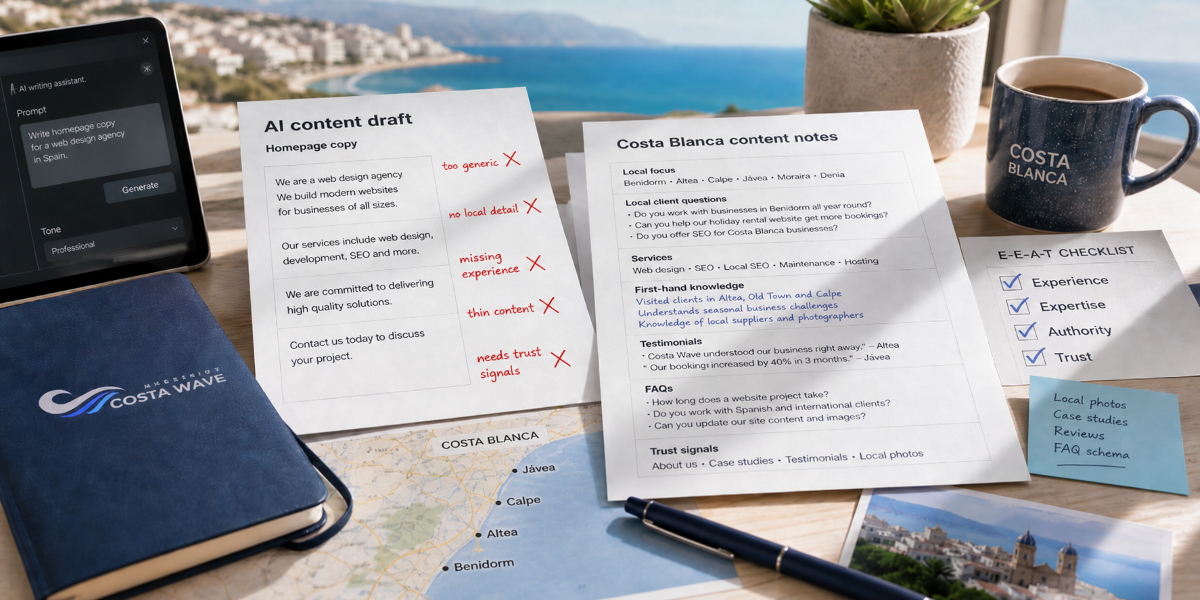
Generic output. A broad prompt often produces copy that could fit many similar businesses. Give the system real information about your services, locations, customers, experience and way of working. The more specific the input, the more useful the draft.
That specificity makes content more convincing. AI can work with it when you provide the information, but it should not be expected to guess what makes your business distinctive.
No real experience. Google's E-E-A-T framework (Experience, Expertise, Authoritativeness, Trustworthiness) comes from Google's quality guidelines. It is not a separate ranking formula that automatically puts human-written text above AI-assisted text. The practical lesson is that content is stronger when real experience, expertise and review are visible, regardless of which writing tools were used.
Hallucinations. AI invents facts. Not always, not obviously, but it happens. If you publish AI content without reading it carefully, you can end up with incorrect claims about your own services, wrong prices, or non-existent features on your website.
It reads like AI. There are specific patterns: certain sentence structures, certain vocabulary, a certain rhythm that's easy to recognise once you know what to look for. Clients on the Costa Blanca making significant decisions (buying property, hiring a contractor for months of renovation work, choosing a lawyer, picking a service business in a country where they don't speak the language) read more carefully than you might think. Generic, polished, hollow content doesn't build the trust you need.
What Google actually thinks about AI content
Google does not apply a general rule of 'human-written good, AI-written bad'. The focus is useful, reliable, people-first content. AI can be part of the production process. Problems arise when content is thin, inaccurate or produced at scale to manipulate search results.
The people-first content and spam policies are more relevant today than referring to a separate Helpful Content system. Google's helpful-content signals are now part of its broader core ranking systems. Publishing large volumes of pages with little added value can be a problem whether or not AI was used.
For businesses on the Costa Blanca, where local SEO requires specific, structured, authoritative content to rank, local relevance still matters. A page should answer a real question and make clear what the business does and where it operates. Thin, near-identical pages for La Nucia, Alfaz del Pi, Altea or Benidorm add little value regardless of how they were written.
The trust problem specific to the Costa Blanca
Your clients are making significant decisions. Moving to Spain. Buying a second home. Hiring someone to renovate a property they can't always check on. Choosing a lawyer or accountant in a different legal system.
They read carefully. They look for someone who clearly knows the area, the market, the specific challenges. They look for a voice that feels real.
Generic polished copy creates little distinction, whether AI or a human wrote it. Strong content contains recognisable details, real expertise and a tone that fits the business.
The practical answer
Use AI to get started. The finished product needs to sound like you.
Let AI produce a draft. Then rewrite it in your own voice. Add specific examples from your actual work. Mention real places, real problems you've solved, real things you've noticed about the Costa Blanca market. Add the detail that only someone doing this work locally for years can add.
For your homepage, your about page, and your main service pages, the pages clients read when deciding whether to trust you: write those properly. Either yourself, or with someone who can write in your voice after understanding your business.
For FAQs, supporting pages, and basic informational content: AI can help, with a strong edit afterwards.
Pages that persuade customers have something specific to say. AI can help structure and phrase that information, but the substance needs to come from real knowledge of your business, customers and market.
If you want a website where both the content and the structure are built to work, send me a message on WhatsApp and I'll tell you what that involves.
Read more: