The Costa Blanca has an international audience, so one language is too limited for many businesses. Which languages matter depends on your actual customers, location and services. A properly built multilingual website gives each chosen language a genuine, indexable place.
Why your Costa Blanca business needs a multilingual website
The Costa Blanca is not a normal market.
Within 30 kilometres between Altea and Calpe, you have Dutch retirees, British expats, Spanish locals, Belgian holiday home owners, German tourists, and seasonal Scandinavian visitors. All potential clients. All searching in different languages. All finding different results.
With one language, you miss searches and visitors using other languages. The size of that opportunity varies by business, so choose languages based on your real audience rather than a fixed Costa Blanca rule.
Your clients search in their own language
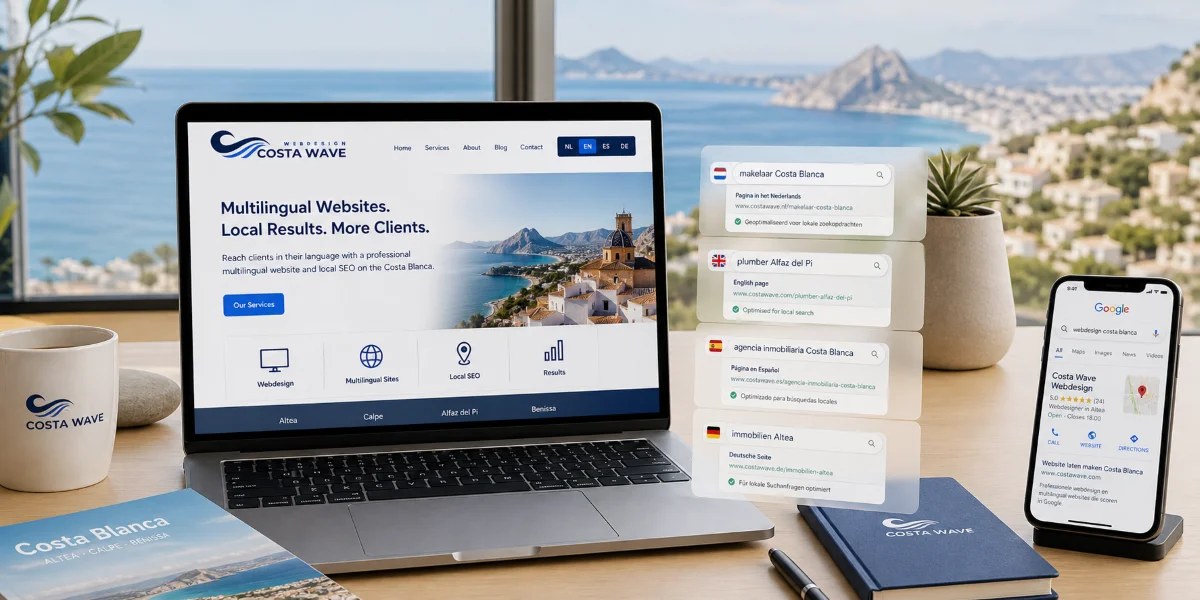
When a Dutch couple in Amsterdam is looking for a real estate agent on the Costa Blanca, they type "makelaar Costa Blanca" into Google. Not "estate agent." Not "inmobiliaria."
When a British retiree in La Nucia wants a plumber, they search "plumber Alfaz del Pi." When their Spanish neighbour has the same problem, they search "fontanero Alfaz del Pi."
These are different searches and Google may show different results by language. Strong separate language versions create the opportunity to be visible for each relevant audience, but do not guarantee rankings for every variation.
People buy in their own language
Research by CSA Research has long shown that language can influence buying preference and trust. Exact percentages vary by study and audience, so the commercial conclusion is more useful than presenting one old figure as universal truth: people often process important information more comfortably in a language they understand well.
Reading about a service in your second language is fine. Trusting someone enough to hand over money, or the keys to your house, in your second language is harder.
A strong Dutch page can reduce friction for Dutch clients, just as English or Spanish can for other audiences. The effect on enquiries varies by sector, content quality and audience and should be measured rather than assumed.
Each language ranks separately
This is the SEO angle most businesses miss.
A properly built multilingual website creates separate, indexable pages for each language. That means "makelaar Costa Blanca" can rank in Dutch search results. "Estate agent Costa Blanca" in English. "Inmobiliaria Costa Blanca" in Spanish. All from the same website, all pointing back to your business.
That's 3 separate opportunities to appear in Google, across 3 different audiences, instead of 1.
Local SEO on the Costa Blanca can have different competition in each language. An additional language creates another opportunity for relevant visibility when the content is strong and there is real search demand; it is not automatically unclaimed SEO territory.
What auto-translation actually does
A client-side translate button that only changes text in the browser, without separate crawlable URLs for that language, generally does not create separate pages Google can index as language versions. That is different from a system that publishes automatic translations as real URLs.
The same distinction applies to other translation tools. Whether a translation is automatic or manual does not determine indexability; factors such as a dedicated crawlable URL and correct technical setup do. The quality of the final translation still matters to users.
Automatic translation can produce awkward or inaccurate phrasing, especially with specialist terminology and local context. Modern translation and AI systems can also produce very usable drafts. Review and adapt important content where necessary.
What proper multilingual actually means
A proper multilingual website has separate URL structures per language: /en/ for English, /nl/ for Dutch, /es/ for Spanish. Each version is its own page, indexed independently by Google, with its own page titles, meta descriptions, and content.
Hreflang helps Google connect equivalent language or regional versions and select an appropriate version in search results. It is a signal, not a guarantee that every user will always see exactly the intended version.
And ideally, the content in each language is adapted, not just translated. A Dutch audience on the Costa Blanca has different questions, different concerns, and different buying habits than a British one.
Who needs this most
Costa Blanca estate agencies often serve international buyers. Language priorities differ by agency. Use your own leads and sales data to decide whether Dutch, English, Spanish, German, French or other languages matter most commercially.
Service businesses working with international residents can also benefit from multiple languages. A Spanish-language website can still be visible, but it will not automatically reach the same searches or create the same level of comfort for Dutch- or English-speaking customers.
Tourism businesses: restaurants, rental properties, activity providers. Visitors from Germany, the Netherlands, and the UK search in their own language before they book.
What you need practically
Choose languages based on your own market. For a business around La Nucia, Alfaz del Pi, Altea or Benidorm, that might mean Spanish and English, with Dutch added when you serve many Dutch or Flemish clients. Another business may benefit more from German or French.
My Business Website package offers additional languages on request. The Professional package also offers multilingual support on request. The current packages therefore do not impose a fixed number of languages; the language setup is tailored to the project.
For multilingual projects I use separate language URLs and hreflang where appropriate. The exact technology or plugin depends on the chosen platform; correct implementation matters more than the label of the technology.
Already have a website in one language and want to add more? That's possible as an upgrade. Send your URL on WhatsApp and I'll tell you exactly what's involved.
Read more: