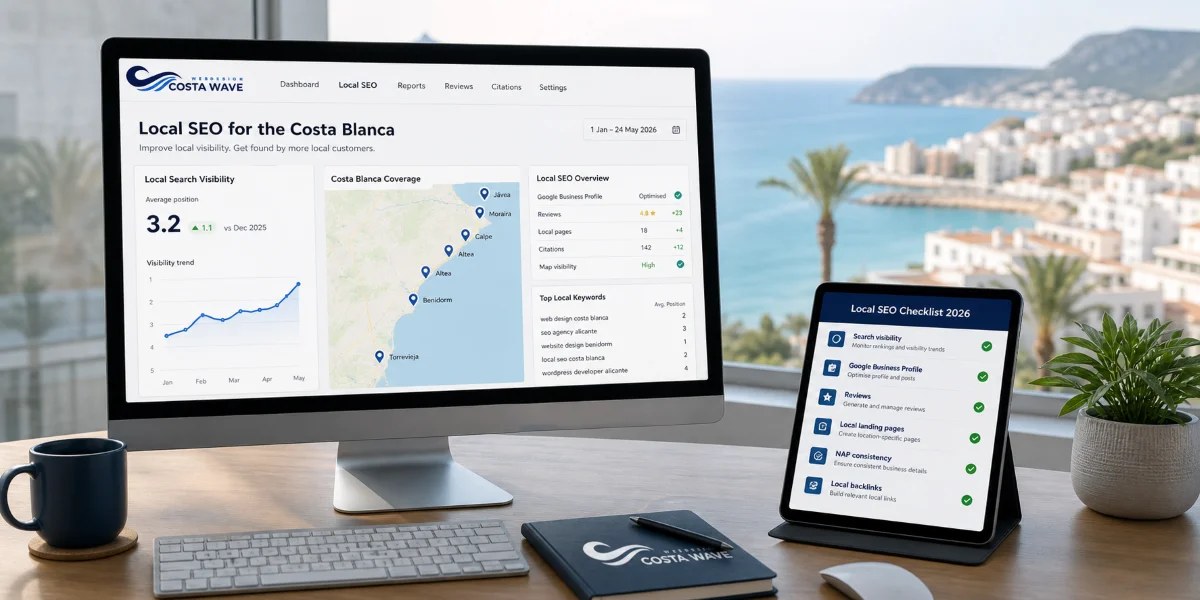
Showing up when someone in Benidorm, Altea, or Jávea searches for your service isn't luck. It's a set of specific things done consistently. Here's what local SEO means for your business on the Costa Blanca, and what works right now.
What local SEO does in practice
Here's an example: someone in Albir searches for "electrician near me". Google shows three businesses on a map, with reviews and a website link. If your business isn't there, it doesn't matter how good your work is nobody finds you.
That's what local SEO does: makes your business visible at the moment someone nearby searches for what you offer. And on the Costa Blanca it works slightly differently from general SEO advice, because your audience searches in three or four languages and often has a specific town in mind before they type a word.
Your Google Business Profile is the starting point
If your Google Business Profile isn't claimed, verified, and properly filled out, the rest matters very little. This is the single highest-impact thing most businesses in Calpe, La Nucia, or Alfaz del Pi can do for free. Choose the right category. Add photos regularly. Keep your opening hours accurate especially around Easter and the summer season when tourists are searching. Answer questions. Reply to every review, good or bad.
I've written a dedicated guide on how to set up Google Business Profile correctly for the Costa Blanca. Start with your Google Business Profile if you haven't already.
NAP consistency: boring work, big effect
NAP stands for Name, Address and Phone number. Keep these details accurate and current on your own website and important business listings. Small formatting differences such as "Calle" versus "C/" are not an official ranking penalty by themselves; what matters more is that Google and customers consistently reach the same business and correct contact details.
Focus on your website, Google Business Profile and relevant business listings. Correct old addresses, wrong phone numbers and duplicate listings. The goal is reliable business information, not word-for-word identical formatting everywhere.
Reviews carry more weight than you'd think
BrightLocal's 2026 Local Consumer Review Survey reports that 97% of surveyed US consumers read online reviews. That figure should not be presented as a Costa Blanca statistic, but it does show how important reviews can be in local decisions. For international Costa Blanca clients, recent detailed reviews are especially useful when trust still has to be established.
Google includes reviews and positive ratings as part of local prominence. Ask satisfied customers for reviews naturally and respond professionally where useful. A larger review count does not guarantee a higher position; relevance, distance and prominence are evaluated together.
Local keywords on your website
Google needs to understand where you operate and what you do. Your website has to spell it out, in the right combinations: your service plus the specific location. "Web designer Benidorm", "plumber Altea", "estate agent Moraira", "English-speaking lawyer Dénia", "physiotherapist Jávea". These belong in your page titles, your H1 and H2 headings, and naturally throughout your text written for the reader, not stuffed in for the bot.
Think about the towns your clients actually come from. For businesses on the northern Costa Blanca (Marina Alta), that's typically Calpe, Benissa, Moraira, Jávea, and Dénia. For the Marina Baixa it's Benidorm, La Nucia, Alfaz del Pi, Albir, and Altea. For the southern Costa Blanca your clients come from Santa Pola, San Fulgencio, Quesada, Rojales, and Torrevieja. If you serve the whole stretch, say so, and create content that mentions these places in context. Google will connect your business to those searches.
The multilingual angle most businesses miss
The Costa Blanca is one of the most linguistically mixed markets in Spain. Your potential clients search in Dutch, English, German, and Spanish sometimes all four, depending on what they're looking for. A Dutch buyer in Moraira types "Nederlandse notaris Dénia". A British expat in Jávea types "English-speaking dentist Jávea". A Spanish neighbour types "fontanero Altea". Three different searches, three separate ranking opportunities.
A properly built multilingual website with separate language structures (not auto-translated pages) tells Google you serve speakers of each language. With it, you can rank for "diseño web La Nucia" in Spanish, "web developer Costa Blanca" in English, and "Nederlandse webdesigner Alfaz del Pi" in Dutch, all from the same site. If you only have one language, or rely on an auto-translation plugin, you're leaving a lot of visibility on the table.
Local backlinks
A backlink is a link from another website to yours. Relevant mentions and links can contribute to your business's authority and visibility, but there is no separate rule that a local backlink automatically carries more ranking weight simply because the source is nearby. Quality and relevance matter more than volume.
Getting listed on Handel met Spanje, joining a Dutch business network like Dameszaken, being linked from a local Facebook group for expats in Benidorm, or featured in a blog about living in Calpe: all of it builds local authority that random links from link directories never build. You don't need hundreds. A handful of relevant, local references do more than a hundred random ones.
Schema markup: tell Google exactly what you are
Schema markup is a small piece of code added to your website that tells Google explicitly what your business is, where it's located, what it does, and how to contact you. The relevant variant for local businesses is called LocalBusiness schema.
Schema markup helps search engines understand certain business and content details more explicitly and can enable supported rich results. LocalBusiness schema is useful when the data genuinely applies to your business, but it does not provide an automatic ranking boost or guarantee a place in the local pack. A technically sound website mainly helps by keeping content, business information and pages clear and crawlable. Do you know whether your website has proper schema markup? A technically sound website is one of the details that helps your business get found, whether you're based in Dénia or Benidorm it's what separates a website that actually performs from one that just exists.
What stopped working
Stuffing keywords into your text. Fake reviews. Buying backlinks from random directories. Hiding your location keyword 50 times in white text on a white background. Google got far better at detecting all of this, and the consequences are real. The businesses ranking well on the Costa Blanca in 2026 are the ones that built genuine authority over time. Shortcuts don't hold up.
Where to start
Start with the basics. Claim and maintain your Google Business Profile, keep business details accurate, ask real customers for reviews and make it clear on your website which services you offer and which towns you genuinely serve. Build relevant local mentions and links where they make sense rather than chasing directories purely for SEO.
That alone puts you ahead of most businesses in Altea, Moraira, or Benissa.
For the technical side, schema markup, proper heading structure, Core Web Vitals your website needs to be built with all of this in mind from day one. Retrofitting it onto a cheap template rarely works well.
Read more: