Someone in Albir searches for "electrician near me". Google shows a small map with three businesses, their reviews and a link to their website. If you're not among them, it hardly matters how good your work is. That client calls someone else.
That's what local SEO is about: being visible at the moment someone nearby searches for what you do. On the Costa Blanca it works a little differently from most SEO advice, because your clients search in three or four languages and often have a specific town in mind.
How Google decides who comes first
For local searches, Google looks at three things: how well your business matches the search, how far you are from the person searching, and how well known and trustworthy you appear online. You can't do much about distance. The other two you can influence.
If those signals are missing, you won't appear, even if your business has been running for years and your clients recommend you everywhere. It isn't a penalty. Google simply doesn't have enough information to show you.
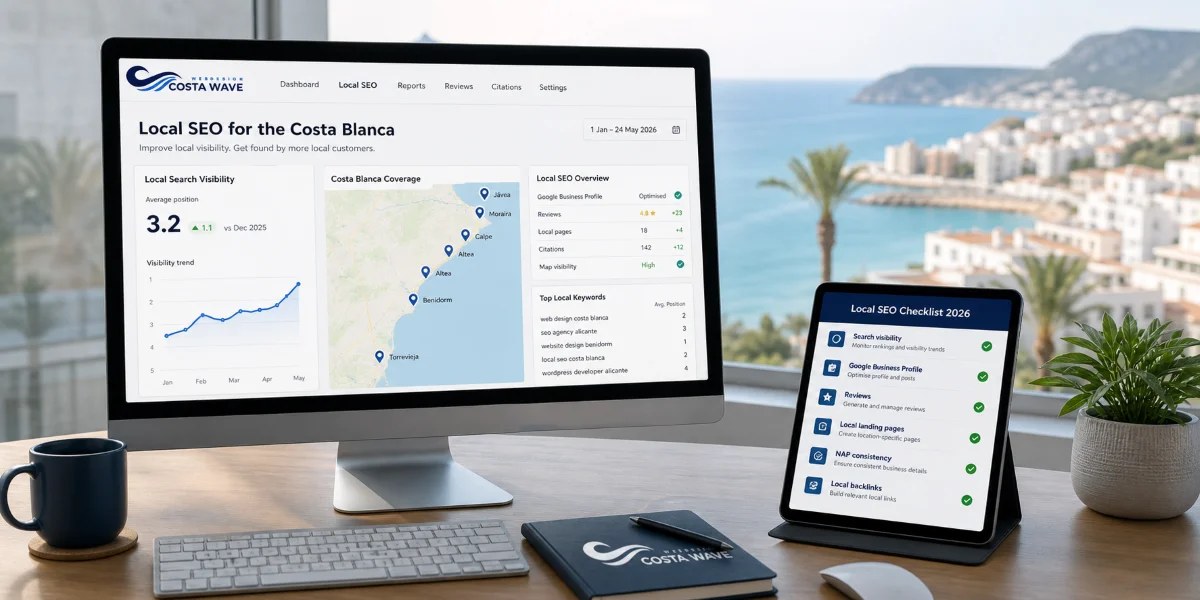
Start with your Google Business Profile
Your Google Business Profile is the free listing that puts you on Google Maps and in that box of three businesses. If it isn't claimed, verified or properly filled in, you're not really taking part. It's the most valuable free thing you can do.
Choose the category that best fits what you do. Add photos of your work and keep adding new ones. Keep your opening hours up to date, especially around Easter and in summer, when lots of tourists are searching. Answer questions and reply to every review, including the less positive ones. You'll find a step-by-step approach in my article on Google Business Profile.
Make sure your details match everywhere
Your business name, address and phone number should be the same on your website, your Business Profile and your other listings. It's dull work, but it helps Google be sure all those listings are about one and the same business.
Don't worry about "Calle" versus "C/". Look out for an old address, a phone number that no longer works or a duplicate listing of your business. Those are the ones you want gone.
Ask for reviews
Google itself names reviews as part of how well known and trustworthy a local business is. And for your clients they carry a lot of weight. Someone who has just arrived from the Netherlands or the UK doesn't know you and has no neighbours to ask. Recent reviews that describe exactly what you did for someone help a great deal.
Simply ask happy clients, preferably shortly after you've finished the job. Send them the link so it takes them very little effort. Fake reviews or buying reviews: don't. Google removes them and it can cost you your profile.
Say on your website what you do and where
Google needs to understand which service you provide and in which towns. That won't happen if your page title is "Home" and your headings say "Our services". Use the combination of your service and the place, the way someone would type it: "estate agent Moraira", "plumber Altea" or "English-speaking physio Jávea". Put it in your page title, your main headings and naturally in the text.
Mention the places your clients actually come from. In the Marina Alta that might be Calpe, Benissa, Moraira, Jávea and Dénia. In the Marina Baixa, Benidorm, La Nucía, Alfaz del Pi, Albir and Altea. Further south, Santa Pola, Rojales, Quesada or Torrevieja.
One trap: making twenty near-identical pages where only the town name changes. Google notices and doesn't appreciate it. A page per area only works if there's something real to say, such as work you've done there or what's different about that place.
The basics on your own pages
These are things you can check yourself without much technical knowledge:
- Page title. This is the clickable heading in Google. "Estate agent in Altea, buying and selling on the Costa Blanca" says far more than "Home | Best Homes Spain". Put the most important part first.
- Description. The short text under that heading is called the meta description. It doesn't affect your position, but it does decide whether someone clicks. Say briefly what people will find on the page.
- Clear addresses. A URL like /estate-agent-altea is easier for Google and for people to understand than /page?id=1234.
- Image descriptions. Give informative photos a short alt text describing what's in them, such as "villa with sea view in Altea". That helps people using a screen reader, and Google.
- Links between your pages. Let a blog article point to the service it relates to, with link text that says where it goes rather than "click here".
Your clients search in several languages
A Dutch buyer in Moraira searches for "Nederlandse notaris Dénia", a British resident of Jávea for "English-speaking dentist Jávea" and a Spanish neighbour for "fontanero Altea". With proper pages per language, you have a chance in each of those searches. A translate button doesn't give you that, because Google doesn't see those translations. How to approach it is covered in my article on multilingual websites.
Listings and links from your own network
Google also looks at whether other websites mention your business. A listing on Handel met Spanje, on the site of a business network such as DamesZaken, on Páginas Amarillas or in a local expat guide shows that your business is real and part of something.
You don't need hundreds. A handful of listings that genuinely fit you does more than a pile of links from random link directories. Look first at the networks you already belong to, the businesses you work with and the organisations in your own town.
What no longer works
Stuffing your text with keywords, fake reviews, buying links or hiding a town name fifty times in white text on a white background. Google recognises all of it, and it can cost you more than it brings. The businesses doing well have built their visibility step by step.
Where do you start?
Claim and fully complete your Google Business Profile. Check that your details match everywhere. Ask your last five clients for a review. Then update the titles of your main pages so they say what you do and where.
That alone puts you ahead of many businesses in your area. The technical side, such as structured data and speed, is best dealt with when your website is built or renewed. Bolting it onto a cheap template afterwards rarely works well.
Want to know why your business isn't showing up? Send me your URL on WhatsApp and I'll tell you what I see.