Most people get vague, generic answers from AI because they ask vague, generic questions. The fix isn't a better tool. It's a better question. Here's how to ask one.
How to ask AI better questions about your business
A lot of people who are disappointed by AI are disappointed for the same reason.
They asked a short, vague question and got a long, vague answer. Then they concluded the tool wasn't very good.
The tool was fine. The question was the problem.
AI gives you back something shaped like what you gave it. A thin question gets a thin answer. A question with context, detail, and a clear goal gets something you can actually use. This article is about how to ask the second kind.
It pairs with our 4-part series on what AI gets wrong. That series was about not trusting AI output blindly. This one is about getting better output in the first place. The two work together: ask better, then still check.
Why the question matters more than the tool
AI only has access to the context available in the current product and conversation. That may include your prompt, but depending on the service it can also include previous chats, memory, files, web results or connected sources. For good results, it is still sensible to state the relevant business context explicitly.
Explain what kind of business you run, who your clients are, what you have already tried and what you want to achieve. Even when an AI product can remember or retrieve extra context, this reduces the chance that important details are missed or filled in incorrectly.
Think of it less like a search engine and more like a new freelancer on their first day. A good freelancer can do excellent work, but not if the entire brief is one vague sentence. The more context you give, the better the result. AI is the same.
The 5 things a good prompt includes
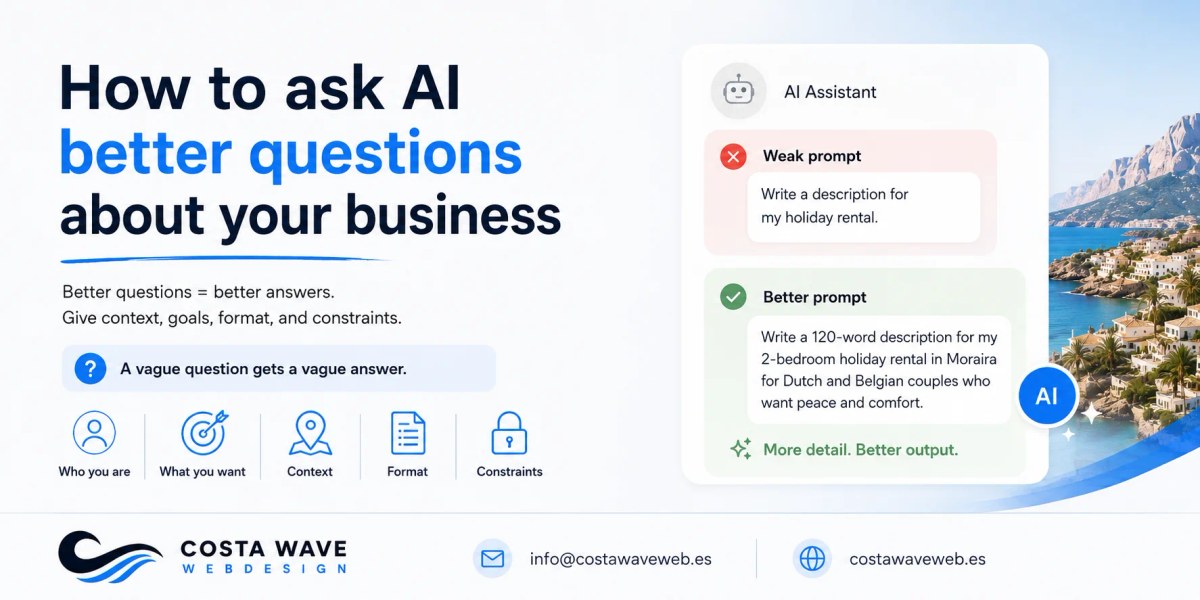
You don't need to be technical. You just need to include more than most people do. A good prompt usually has 5 parts.
1. Who you are. Give the AI your context. "I run a small painting and maintenance business on the Costa Blanca. Most of my clients are foreign homeowners who don't live here full time." That single sentence changes every answer that follows.
2. What you actually want. Not "help with marketing." That's a topic, not a request. Try "I want 5 ideas for getting repeat work from clients I've already done a job for." Specific request, specific answer.
3. The context around it. What have you already tried? What's the situation? "I've tried sending a follow-up email but I rarely get a reply." Now the AI knows not to just suggest follow-up emails.
4. The format you want back. AI will guess if you don't tell it. So tell it. "Give me a short list, no long explanations." Or "Write this as a friendly WhatsApp message, not a formal email." Or "Keep it under 100 words."
5. The constraints. The limits it needs to respect. "I don't want to offer discounts." "It needs to work without a big advertising budget." "Keep the tone calm and professional, not pushy."
You do not have to label these parts formally. A clear brief with context, goal, format and constraints will usually produce better results than a vague one-line question, although quality still depends on the model and the task.
A real example: weak prompt vs strong prompt
Here's the difference in practice.
Weak prompt: "Write a description for my holiday rental."
What you'll get back is generic. It could describe almost any property anywhere. Sunny, comfortable, ideal for families, close to amenities. True of thousands of listings. It sells nothing.
Strong prompt: "Write a description for my 2-bedroom holiday rental in Moraira. It's a 10-minute walk from the beach and has a private pool and a shaded terrace. My typical guests are couples in their 50s and 60s, often Dutch or Belgian, who come for 1 to 2 weeks and want quiet, not nightlife. Emphasise the calm, the comfort, and the easy walk to the beach. Keep it warm but not over the top. Around 120 words. Don't use clichés like 'home away from home'."
The second prompt gets you something specific, usable, and close to done. Same tool. Completely different result. The only thing that changed was the amount of thought that went into the question.
A few more examples, for different jobs
The same principle works for almost anything you'd use AI for. Here are 4 more, each one written the strong way.
Replying to a difficult customer (maintenance business): "A client emailed to complain that a job took longer than I estimated. The delay was real but it was caused by a problem I couldn't have seen until I started. I want to reply in a way that's honest, takes responsibility for the communication, but doesn't grovel or offer money back. Keep it short, calm, and professional. Write it as an email I can adjust."
Getting unstuck on content (restaurant): "I run a small restaurant in Jávea. I want to write a short piece for my website about why our menu changes with the season, but every version I write sounds boring. Ask me 5 questions that would help you understand what makes my approach actually different, so I can answer them and you can use the answers."
Planning, not just writing (retail shop): "I have a small homeware shop in Altea. Low season is coming and footfall always drops. Give me 8 ideas for keeping revenue steadier through the quiet months. I don't want to rely on heavy discounting, and I don't have a big budget. For each idea, add one line on the main downside so I can judge it realistically."
Turning notes into something usable (any business): "Here are my rough notes from a customer meeting: [paste notes]. Turn them into a short, clear summary with any action points listed separately. Don't add anything that isn't in my notes. If something is unclear, list it as a question rather than guessing."
Notice the pattern in all of them. Context first, then a specific request, then the format, then the limits. And notice the last two don't even ask AI to "write" something final. One asks it to plan, one asks it to ask you questions, one asks it to organise what you already have. AI is often more useful as a thinking partner than as a finished-text machine.
Follow-up questions are part of the process
Here's something most people miss: the first answer is rarely the finished answer. It's a draft to react to.
You don't have to accept what AI gives you and walk away. You can push it.
"That's too formal, make it warmer." "The second idea is the best one, give me 3 variations of just that." "You used the word 'nestled', never use that word." "This sounds like every other website, what would make it sound like a real person wrote it?"
The first response does not need to be the final version. Giving focused feedback on tone, length, missing information or weak ideas can improve the result step by step. Good outcomes usually come from a short iteration rather than one perfect prompt.
What still applies from the rest of the series
Better prompting can produce better drafts and analysis. It does not automatically make factual information trustworthy.
A detailed, well-built prompt asking about tax rules for self-employed workers in Spain will get you a detailed, confident, well-structured answer. It can still be wrong, out of date, or based on another country. A good question improves the writing. It doesn't verify the facts.
So everything from the rest of the series still stands. Use AI for the draft, the structure, the ideas, the rewording. Then check anything that matters against a real source, add what only you know, and make sure it actually applies to Spain and to your area.
Ask better questions to get better drafts. Keep checking to make sure those drafts are true.
The short version
If you remember one thing: a vague question is the reason for a vague answer.
Before you hit enter, give the AI your context, tell it exactly what you want, explain the situation, say what format you want back, and name your constraints. Then treat the first answer as a draft and push it with follow-ups.
That's the whole skill. It's not technical. It's just the difference between asking properly and asking lazily.
If you want to know whether the content on your website reads like it was built with care or generated in a hurry, send me your URL on WhatsApp and I'll give you a straight answer.
Read more: