AI is genuinely useful. It saves real time and gets you past the blank page. The question is how to use it without letting it make decisions you should be making yourself. Here's a practical answer.
How to use AI without blindly trusting it
After 3 articles about what AI gets wrong, here's the part that actually matters for your daily work: how to use it well.
AI saves time. It helps you get started. It handles the parts of the job that are repetitive and low-risk. Used properly, it makes you faster without making you careless.
The key word is properly.
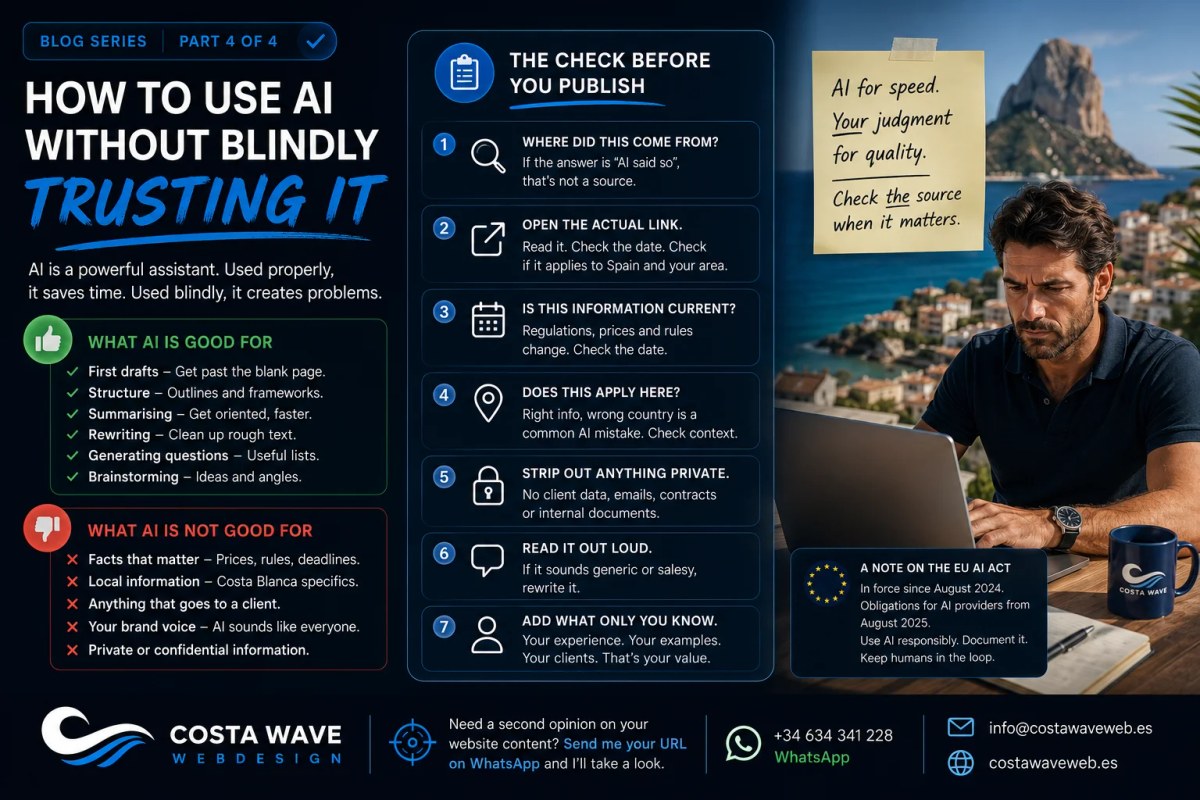
What AI is actually good for
Start with what it does well, because the list is real.
First drafts. This is where AI earns its keep. A blank page is one of the most time-consuming things in any business. AI gives you something to react to, edit, cut down, and improve. That's much faster than writing from nothing.
Structure. Ask AI to outline a blog post, a proposal, or a service page and you get a skeleton. You fill it with your actual knowledge, your real examples, your specific prices, your local context. The structure is the starting point, not the finished product.
Summarising. If you have a long document to read or a topic to research, AI can condense it quickly. Useful for getting oriented. Dangerous if you stop there without checking the original.
Rewriting rough text. You have notes. You have a draft that doesn't quite work. AI can make it cleaner. As long as the facts in the draft are yours and correct, this is low-risk.
Generating questions. Ask AI what questions a client buying a property in Jávea would typically have, or what a tourist arriving in Benidorm for the first time usually wants to know, and you get a useful list. The questions are often good even when the answers need checking.
Brainstorming. Blog topics, social media angles, ways to explain a service: AI generates volume quickly. You pick what's useful and discard the rest.
What AI is not good for
Facts that matter. Prices, regulations, legal rules, tax obligations, opening hours and deadlines should be checked against current sources. AI can help search and summarise, but open the original source and verify the date, jurisdiction and context before relying on it.
Local Costa Blanca information needs extra context. Rules for a business in Calpe, a tourist-rental licence in Altea or planning rules in Moraira can depend on Spain, the Valencian Community and the municipality. AI can help find sources or organise information, but important decisions should still be checked against an official source or qualified professional.
Anything that goes to a client. Before any AI-assisted content reaches a client, a customer, or the public, a human has read it and confirmed it's accurate. Not skimmed it. Read it.
Your brand voice. With a vague brief, AI can easily produce generic copy. With good examples, clear style rules and focused feedback, it can match your tone much more closely. You should still read the final version yourself and remove wording that does not sound like your business.
The check you should run before publishing anything
This is the practical part. Before anything AI helped write goes on your website, into a document, or out to a client, run through this:
1. Where did this claim come from? If there's a fact, a statistic, or a specific piece of advice, ask where it originated. If the answer is "AI said so," that's not a source. Find the original.
2. Open the actual link. Not the title preview. Not the AI summary of what the page says. Open the page itself, read the relevant section, check the date, check whether it applies to Spain and specifically to your area.
3. Is this information current? Regulations change. Prices change. Rules for businesses in Spain have changed significantly in the past few years. "This was true in 2022" is not the same as "this is true now."
4. Does this apply to Spain, and to this region? A common AI mistake is giving you the right information for the wrong country. Legal requirements in the UK, tax rules in the Netherlands, property processes in France: none of these are the rules for a business or buyer in Altea, Calpe, or Jávea. Check the country, check the region, check the specific context.
5. Strip out anything private before you paste it in. Be deliberate with personal data and confidential business information. Do not paste sensitive client data, contracts or internal documents into an AI service unless that fits your agreements, privacy obligations and the service's data handling. Share as little sensitive information as possible and anonymise where practical.
6. Read it out loud. If it sounds like a company brochure from 1997, cut it. AI defaults to a certain smooth, generic tone that sounds polished but says nothing specific. Real business writing sounds like a person wrote it because they knew something worth saying.
7. Add what only you know. The specific example from last month's job in Moraira, the question Dutch clients keep asking or the experience only you have from doing the work. An AI system can only use that information when it is available through your prompt, files, memory or connected sources. Your own expertise therefore remains essential.
A note on the EU AI Act
If you run a business in Spain, or in Europe generally, the EU AI Act is worth knowing about.
The AI Act entered into force in August 2024 and has been broadly applicable since 2 August 2026, with exceptions and later deadlines for certain high-risk systems. Transparency obligations under Article 50 also apply from 2 August 2026 to certain AI systems and AI-generated or manipulated content. Which obligations apply to your business depends on your role, the system you use and the type of use case.
For a small business using AI for ordinary writing assistance, the practical point is to know which tool you are using, review what you publish and recognise when transparency, privacy or other legal rules may apply. Deepfakes, direct AI interaction with users and certain AI-generated public-interest content can trigger specific transparency duties. For legal assessment of your own situation, use official EU guidance or professional advice.
The bottom line
AI makes you faster. It doesn't make you better by itself.
Costa Blanca businesses that use AI well treat it as a tool that can accelerate work while applying an appropriate level of review. How much checking is needed depends on the task and the consequences of an error.
Use it for speed. Use your own judgment for quality. And when something matters, check the source.
If you want to know whether your website content holds up to that standard, send me your URL on WhatsApp and I'll give you a straight answer.
Read more: