Most businesses on the Costa Blanca have a website. Very few have one that works. Here's what the difference looks like in practice, from the things visitors notice to the things they never see.
What makes a good website? A practical guide for businesses on the Costa Blanca
Most businesses on the Costa Blanca have a website. Far fewer have one that actually works.
The gap between those 2 things is rarely obvious from looking at the site. It's in how it performs: how fast it loads, whether visitors understand what they're looking at, whether they have a clear reason to get in touch, and whether Google can make sense of it.
Here's what a genuinely good website does.
It makes what you do clear quickly
A visitor forms an early impression and tries to decide whether the page is relevant. The quicker the core message becomes clear, the less effort it takes to understand what you offer.
If the message stays vague, visitors are more likely to keep looking elsewhere. There is no universal five-second rule that applies to every website and every visitor.
Many websites on the Costa Blanca open with something vague: a large background image, a slogan like "quality you can trust" or "your partner in success," and no clear explanation of what the business actually does or who it serves.
A good website answers the basics immediately: what you do, who it's for, and where you operate. "Web design for businesses in Altea, Calpe, and Jávea" is immediately clear. "Digital solutions for modern businesses" is not.
The homepage isn't the place to be clever. It's the place to be understood.
The small details signal quality
Visitors form impressions quickly. And they notice more than business owners often realise.
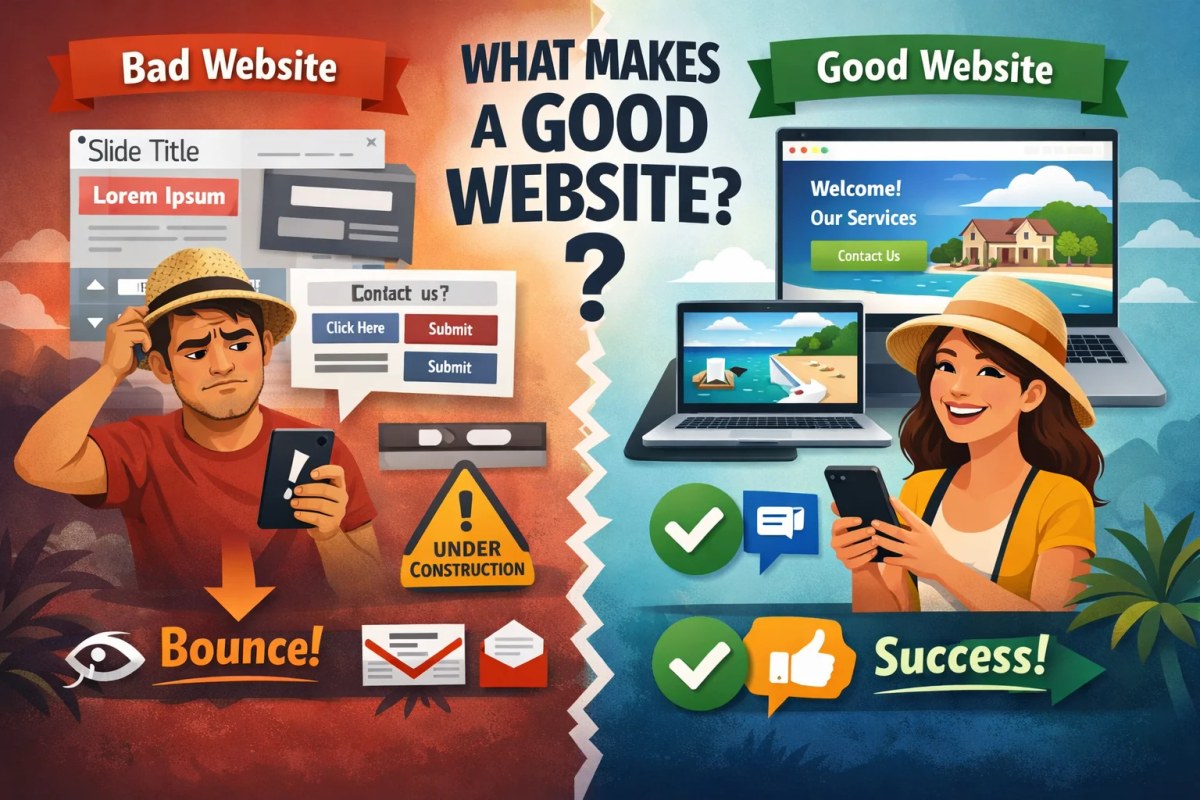
Text that's slightly misaligned. A button that doesn't look clickable. A menu that's hard to navigate. Placeholder text that was never removed: "Slide title" or "Write your caption here" sitting in a live page.
None of these things are catastrophic on their own. Together they send a signal: this site was thrown together. And if the site looks like it wasn't taken seriously, the business behind it raises the same question.
A good website is clean and consistent. Every element earns its place. Nothing looks half-finished.
Colour contrast is a readability issue, not a design preference
Some websites use colour combinations that look attractive in a design tool but are genuinely hard to read on screen: light grey text on a white background, blue text on a dark blue background, buttons that barely stand out from the page around them.
On a laptop in a dim room it might be acceptable. On a phone in the Spanish sunshine it becomes unreadable.
The Coolors contrast checker lets you test any colour combination in seconds. International accessibility guidelines recommend a minimum contrast ratio of 4.5:1 for normal text. Below that, some visitors will struggle to read it, and some won't bother trying.
Mobile deserves full attention
Mobile traffic represents a large share for many websites. Your own analytics will show how large that share is for your business. Design and test for phones and smaller screens as carefully as for desktop.
A site that works on desktop but becomes awkward on mobile makes things harder for visitors. Common issues include small controls, text that needs zooming, images outside the viewport and menus that do not work properly.
Test on a real phone. Not a browser with a narrowed window. An actual device, with your thumb, the way your clients use it.
Speed affects the experience
Long waits increase the chance that visitors leave, but there is no universal threshold where most people abandon a page at exactly three seconds. Measure the actual experience and identify where delays become noticeable.
This is especially relevant for businesses on the Costa Blanca, where a lot of your audience is browsing on a mobile connection rather than WiFi. Cheap hosting, uncompressed images, and too many plugins can contribute, but so can scripts, fonts, external embeds, application code and server configuration. Plugin count or hosting price alone does not tell you how fast a website is.
You can test your own site for free at pagespeed.web.dev. Use the score and recommendations as diagnostics, not as a direct Google ranking score. Where possible, also look at Core Web Vitals and real-user data; one Lighthouse run does not tell the whole story.
There is a clear next step where one is needed
A visitor who wants to continue should understand the next step without unnecessary searching. That might be contacting you, viewing a property, booking an appointment, checking prices or reading more information.
Use clear calls to action on pages where a next step makes sense. That may be a quote button, phone number, WhatsApp link, booking action or relevant internal link. Placement and format should fit the content and visitor rather than follow a fixed rule.
Google can read it properly
A website can look good and still have technical or content SEO problems. Examples include poor indexability, unclear titles, weak internal links, incorrect language setup, thin content or crawling issues. Meta descriptions and alt text have their own purposes, and missing them does not automatically make a page invisible.
Google needs to be able to find, render and understand a page. When important parts of that process fail, visibility can be limited. That is different from saying one missing SEO element means the site simply will not appear.When that structure is missing, the site simply doesn't appear in search results, regardless of how good the design looks.
A good website is built for both its visitors and the search engines that send them there.
If you want to know where your site stands on any of these points, send me your URL on WhatsApp and I'll tell you exactly what I find.
Read more:
Gallery