Google, ChatGPT and other search and answer services increasingly show AI-generated answers alongside or above traditional search results. GEO is a general term for improving the chance that your content can be found, understood and used as a source in those experiences. It is not a separate trick from SEO; it largely builds on the same foundation.
Search doesn't work the way it did last year
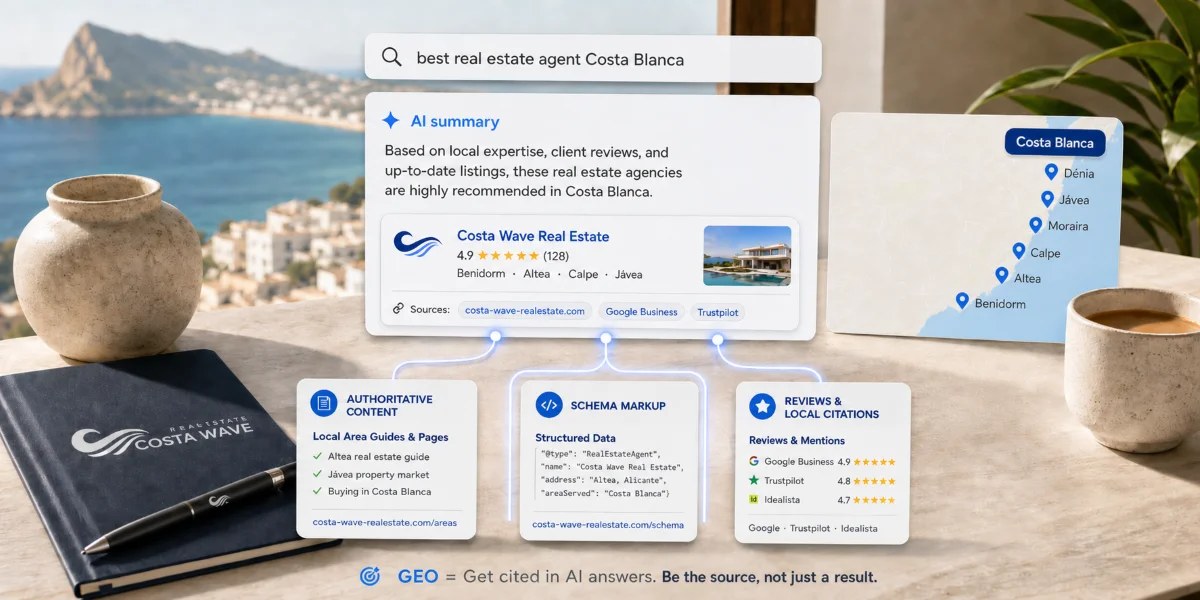
Type "best estate agent Moraira" or "English-speaking notary Dénia" into Google, and the first thing you see is often no longer a list of links. It's an AI summary of a few lines, generated by Google's AI Overview, pulling from multiple sources and answering the question directly. No click needed. The same thing happens in ChatGPT, Bing Copilot, and Perplexity though there it's usually longer answers with explicit source citations.
Those summaries are pulling from somewhere. The question for you is whether they're pulling from your website, or from a competitor's.
What GEO actually is
GEO stands for Generative Engine Optimization. In practice, it means making content clear, useful and trustworthy enough for search engines and AI systems to find and interpret. No method can guarantee that your business will be cited in an AI answer. Google does not recommend special GEO markup or a separate optimisation technique for AI Overviews or AI Mode beyond normal SEO.
GEO doesn't replace SEO; it builds on it. A strong local SEO foundation is still the base, and businesses already ranking well there have a significant head start.
How AI decides what to cite
Studies of AI citations can be useful snapshots, but they change quickly and should not be treated as fixed ranking rules. A 2025 Seer Interactive study found strong overlap at that time between ChatGPT citations and Bing results. That does not mean ChatGPT visibility in 2026 is simply determined by Bing ranking; search products, sources and models continue to change.
The practical conclusion is less dramatic but more useful: make important pages crawlable, accurate and genuinely useful. Strong traditional search visibility can help because high-quality sources are also useful for AI answers, but there is no fixed formula where a Google or Bing position automatically produces an AI citation.
What AI systems specifically reward
There is no official list of five factors that AI systems specifically reward. What does help in both search and AI answers is clear information, logical structure, factual accuracy, relevant sourcing and content that demonstrates real experience or expertise.
- Direct answers up front. Giving a direct answer helps readers and makes a page easier to understand, but it does not guarantee that the sentence will be cited. Put the answer early because that improves the content, not because it is a proven AI-ranking signal.
- Structured layout. Clear headings, short paragraphs and logical sections make content easier to read and process. FAQ sections can still be useful for users, but Google removed FAQ rich results from Search in 2026. Use FAQs because the questions matter, not as a visibility shortcut.
- Schema markup. Structured data can help search engines understand certain information more explicitly, such as Article or LocalBusiness data when it genuinely applies. Most websites on the Costa Blanca don't have it. Google explicitly says no special schema markup is required for AI Overviews or AI Mode. Use structured data only where it is supported and accurate.
- E-E-A-T signals. Experience, Expertise, Authoritativeness and Trustworthiness come from Google's quality guidelines. They are not separate AI-ranking factors. Specific, verifiable experience can still make content more useful and credible, such as an estate agent answering real buyer questions from Costa Blanca transactions.
- Citations and backlinks from local sources. Relevant mentions and links can support a business's authority and discoverability. That includes local media, industry organisations and other trusted sources. There is no simple rule that more local links automatically cause an AI system to cite you.
What's different from traditional SEO
In traditional search, position 1 means someone clicks your link. In AI search, being cited means you're mentioned in the summary, sometimes with a clickable source, sometimes just by name in flowing text. The user reads the answer, sees your business name, and decides on that basis whether to look further.
The goal shifts from "hitting rankings" to "being cited as the source that answers the question". For some searches that means fewer clicks, but stronger brand recognition with the people who do end up reaching out.
What this means for Costa Blanca businesses right now
For many local Costa Blanca businesses, the biggest opportunity is still the basics: strong local SEO, accurate business information and content that answers real customer questions. For specific Dutch- or English-language searches around La Nucia, Alfaz del Pi, Altea, Benidorm and nearby towns, clear local content can help, but competition and citation likelihood vary by topic and platform.
A business in Altea, La Nucia, or Moraira that builds a properly structured, authoritative website now, with direct answers to those specific questions in English, Dutch, and Spanish, is positioning itself as the source AI pulls from once those questions get asked more often. That window won't stay open for years.
Where to start
GEO and SEO largely share the same foundation. Good SEO, useful content and clear entities create a stronger base for both traditional search and AI search experiences without requiring a separate technical GEO layer.
In practical terms: make sure your website loads fast, has clean technical structure, and a logical architecture. Write content that answers real questions with specific, experience-backed detail not generalities anyone could have written. Add schema markup where it makes sense. Build local citations through the Spanish and English platforms your audience actually uses. Keep your Google Business Profile complete and current, with regular updates and photos.
The businesses that appear in AI answers two years from now as the go-to source for "English-speaking web designer Costa Blanca" or "estate agent for expats Moraira" are the ones starting to build that authority today.
Read more: