AI can now build a surprisingly complete website very quickly, and the technical result can be perfectly good. The risk is not the use of AI itself, but what happens when design, content, SEO and strategy are not properly reviewed. A good-looking website is not automatically a website that generates clients.
Why an AI-built website won't bring in clients
This one is new. And it's showing up all the time now.
A business owner spends an afternoon with an AI tool, prompts it to build a website, sees something that looks reasonable, and hits publish. A few months later: nothing. No visibility, no enquiries, no results.
The website looks like a website. It just doesn't work like one.
The output is only as good as the input
AI website tools produce results based on what they're told to build. The problem is that most people giving those instructions don't have a background in web design, development, content strategy, or SEO. And they have no way of knowing when the output is wrong.
Modern AI tools can already check and suggest a great deal. They can create structure, flag technical issues and add SEO elements. But they only understand your commercial priorities and local market to the extent that you provide or connect that context. Quality control therefore remains part of the job.
A capable AI tool can create a heading structure, call to action and conversion suggestions. The useful question is whether those choices are right for your visitors and business goal. That still requires review and iteration.
The tool only knows your business through the context available to it
An AI tool can process a great deal of information about your business when you provide it through prompts, files, existing content or connected systems. What it does not automatically have is your full commercial judgement: which clients you most want, which objections you hear in real conversations and what actually matters in your local market.
You can provide that context. The better the information about audience, tone, services, region and customer questions, the better the system can assist. Without it, generic choices are more likely.
Plausible and effective are 2 different things.
The hero section ends up talking about the business instead of the client's problem. Service descriptions are vague. Calls to action are missing or buried. These aren't cosmetic issues. They're the difference between a visitor enquiring and a visitor closing the tab.
The technical side still needs checking
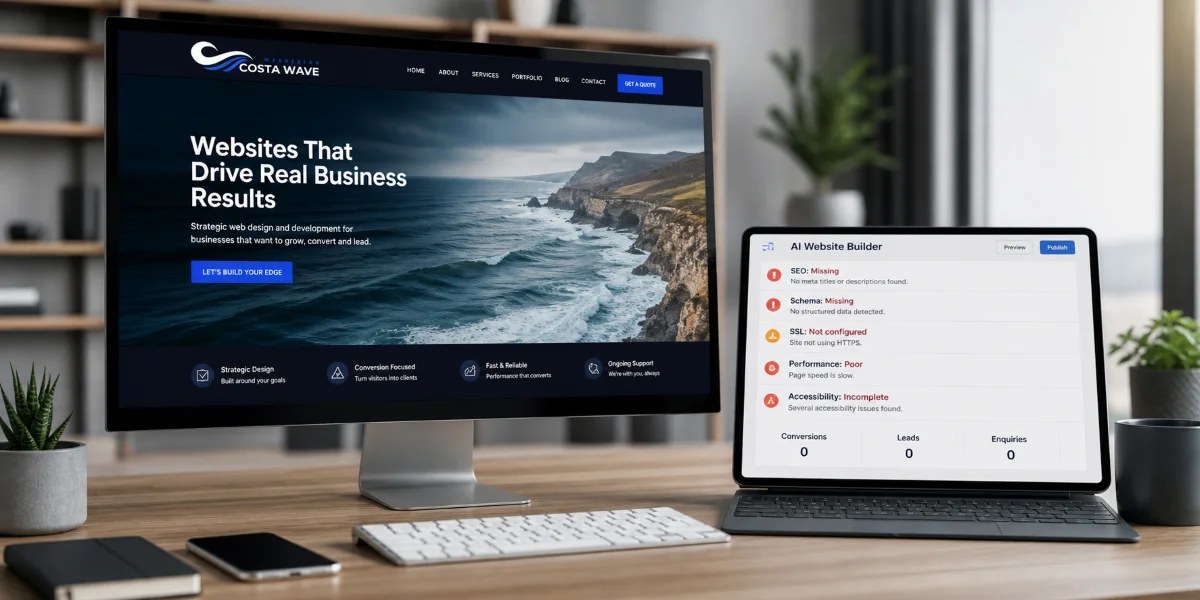
AI website builders vary considerably. Some handle SSL, sitemaps, metadata, responsive design and image optimisation automatically; others leave more responsibility to you. You cannot judge the technical foundation from the visual preview alone, so check what the platform actually delivers.
Review page titles, indexability, headings, canonical and language settings where relevant, images, sitemaps, performance and structured data where it genuinely applies. Not every project needs the same things and schema markup is not a general ranking boost.
A site can look polished and still fail Google's Core Web Vitals, including loading performance, visual stability and interaction responsiveness. Test the finished site on real pages and devices. An AI-built site can perform extremely well, but it should be measured rather than assumed.
The person who built it can't see what's wrong because they don't know what to look for. That's not a criticism. It's just what happens when you use a tool without the knowledge to judge its output. You can't proofread a language you don't speak.
Content still matters for AI search
Search is changing fast. AI-powered summaries at the top of Google, ChatGPT, and Bing now answer a lot of questions before people even click a result.
Google AI Overviews, ChatGPT Search and other systems can use sources from the web. There is no separate guarantee that a particular technology stack or schema markup will make you visible in them. A crawlable website with useful, reliable and specific content creates a stronger foundation for both traditional search and AI search experiences.
An AI-built website can therefore be visible in search. The issue is not that AI built it, but that important decisions about content, technical quality, local relevance and conversion may remain untested.
AI is a tool, not a strategist
I use AI as part of how I work. A lot of developers do now.
The problem is treating it as a replacement for the thinking that has to happen before and around it: the strategy, the structure, the understanding of the business and the people it's trying to reach.
A website built with AI can be excellent. AI lowers the barrier and accelerates a lot of work. The quality ultimately depends on the brief, platform, content and review of the finished result.
The barrier to building something is lower. That makes the ability to evaluate what has been built more important than before.
What to do if this sounds familiar
If you had a site built this way and it's not performing, the right starting point is a proper audit. An honest look at what's actually there, what's missing, and what needs to be fixed.
In a lot of cases, the site can be improved significantly without rebuilding from scratch. In others, it's faster and cheaper to start clean.
Either way, you need to know what you're actually dealing with first.
Send me your URL on WhatsApp and I'll give you a straight answer.
Read more: