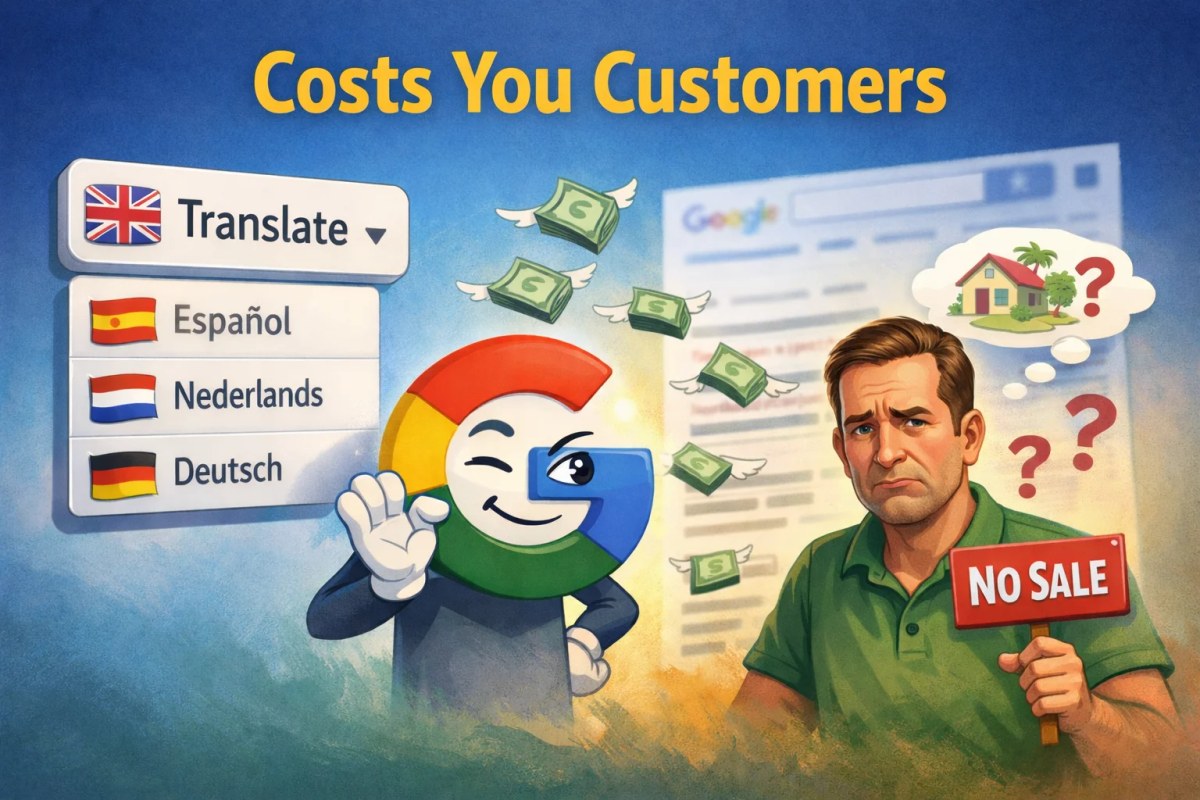
Why a Language Button Costs You Customers on the Costa Blanca
Many businesses on the Costa Blanca serve international clients.
Real estate agencies, architects, lawyers and service companies all work with buyers from countries such as the Netherlands, the UK, Germany and Belgium.
Because of this, many websites add a language button or automatic translation widget. At first glance this seems like a simple solution.
But in reality, these tools often cost businesses customers, search visibility and trust.
What a Language Button Actually Does
A language button usually uses automatic translation technology such as Google Translate.
When a visitor clicks the button, the text on the page is translated inside the browser. The original website itself does not change.
This means:
- The translated content does not exist as a real page
- Google cannot index the translated version
- The page has no separate URL for another language
In other words, the website may look multilingual to visitors, but for search engines it is still a single-language website.
Why This Hurts SEO
Search engines rank pages, not translations generated in a browser.
If your website only has one real page, Google can only index that version.
For example:
If your website is in Spanish but your clients search in Dutch or English, Google has nothing to show them.
On the Costa Blanca this is a serious problem. Many potential clients search for things like:
- property for sale Costa Blanca
- architect Costa Blanca
- real estate agent Altea
- villas for sale Costa Blanca
If your website does not exist in those languages as real pages, your business simply cannot rank for those searches.
This means potential clients will find your competitors instead.
Automatic Translations Damage Trust
SEO is not the only issue.
Automatic translations often produce strange or incorrect sentences. This can make a website feel unprofessional.
Imagine a potential property buyer from the Netherlands reading poorly translated text about a house or legal service. It immediately raises doubts.
People may start asking questions such as:
- Is this company reliable?
- Do they really work with international clients?
- Will communication be difficult?
Trust is extremely important in industries such as real estate and construction, where projects involve large investments.
Why Language Buttons Are Still Popular
Despite these problems, language buttons are still very common.
There are three main reasons.
First, they are easy to install.
A simple plugin can add a translation button within minutes.
Second, they appear to solve the problem quickly.
Business owners often assume that a translated page means their website is multilingual.
Third, many standard website templates include them by default.
For example, many real estate websites using CRM templates rely heavily on translation widgets instead of real multilingual pages.
However, this convenience comes at a cost.
What Actually Works: Real Multilingual Websites
A real multilingual website works differently.
Instead of translating content in the browser, each language has its own pages and URLs.
For example:
- /en/real-estate-costa-blanca
- /nl/huis-kopen-costa-blanca
- /de/immobilien-costa-blanca
Each page can then have:
- its own SEO title
- its own meta description
- optimized keywords for that language
- properly written content
This allows search engines to index each version individually.
As a result, your business can appear in searches in multiple countries.
Why This Matters on the Costa Blanca
The Costa Blanca is an international property market.
Buyers come from across Europe and often search in their own language.
A multilingual website allows your business to be visible for searches like:
- huizen te koop Costa Blanca
- property for sale Costa Blanca
- immobilien Costa Blanca
- casas en venta Costa Blanca
Without real multilingual pages, your website will miss a large part of this traffic.
For businesses that rely on international clients, this means losing potential leads every day.
A Better Approach
Instead of relying on a language button, businesses should build a website with a proper multilingual structure.
This includes:
- separate pages per language
- correct SEO titles and descriptions
- clear language URLs
- professional translations
This approach takes more effort initially, but it delivers far better results in terms of visibility, trust and conversions.
If you want to learn more about improving your website, you may also find these articles helpful:
- Why every real estate agent needs a professional website
- Website success in Costa Blanca: The power of speed, deisgn & trust
- 5 Conversion killers on your website and how to fix them
External resources:
- https://developers.google.com/search/docs/specialty/international
- https://moz.com/learn/seo/international-seo
Conclusion
A language button may seem like an easy solution, but it does not make your website multilingual.
Instead, it often harms your visibility in search engines and can reduce trust with international clients.
For businesses on the Costa Blanca that depend on international visitors, a properly structured multilingual website is essential.
Investing in real multilingual pages allows your business to reach more clients, rank in multiple languages and build stronger credibility online.