Automatic translation is not an SEO problem by definition. The important distinction is between a translation feature that only transforms an existing page for the visitor and a multilingual website with separate, crawlable language versions that have been reviewed for quality.
Automatic translation and SEO: what works in 2026?
For Costa Blanca businesses, multilingual content often makes commercial sense. Customers search in Spanish, English, Dutch and other languages. The relevant question is not whether translation technology may be used, but how the final language versions are structured and reviewed.
Browser translation or a translation widget can be useful to a visitor, but it does not automatically create a complete SEO structure for every language. That requires separate language URLs, clear language relationships and quality content.
A language button is not the same as a multilingual website
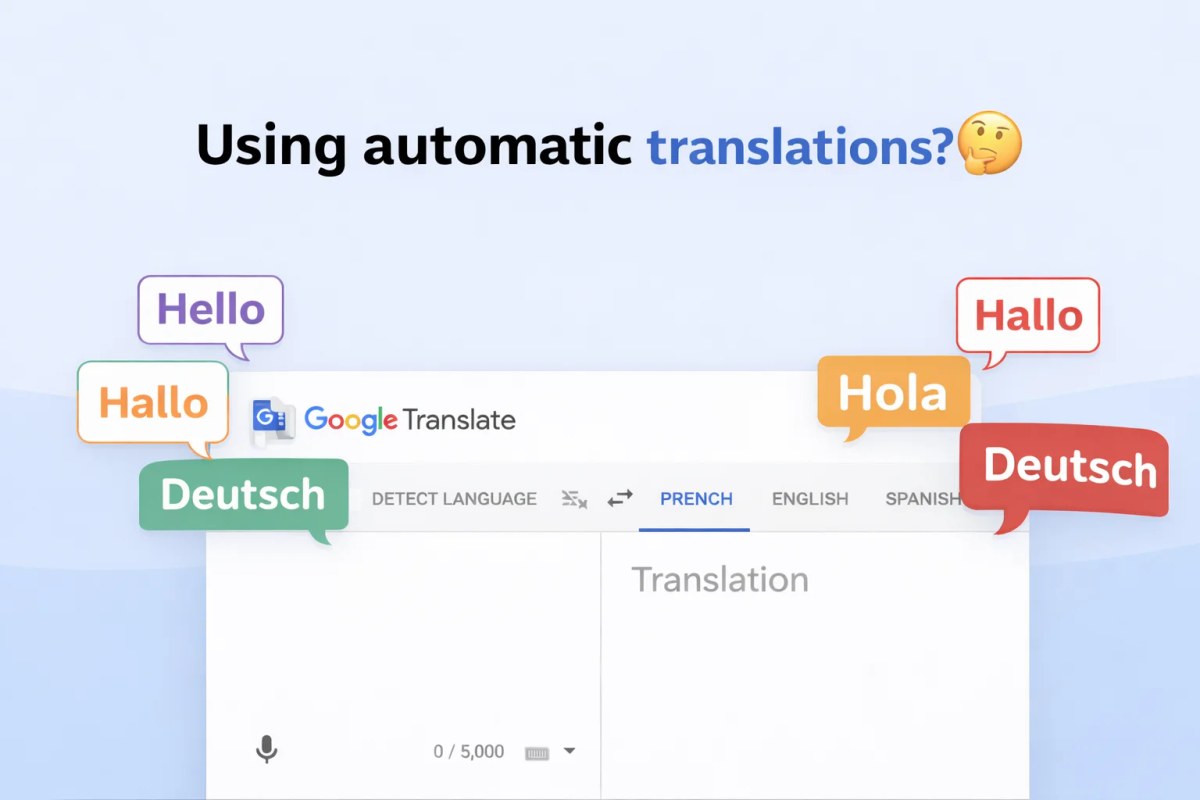
A language button or translation widget can translate the existing page in the visitor's browser. That is different from a website where Dutch, English or Spanish versions exist as independent pages. A widget changes what the visitor sees, but it does not automatically create a separate language URL that can be optimised and indexed as its own page.
- a translation widget can be useful as an extra visitor aid;
- but the translated view is not automatically an independent SEO page;
- for proper multilingual SEO, each language version needs its own crawlable URL;
- hreflang helps search engines connect equivalent language and regional versions.
There is also a practical change in 2026: Google announced that the Google Translate Website Translator Widget will no longer be supported from October 1, 2026. Sites still relying on that widget therefore need to decide how their multilingual setup will work afterwards.
What Google actually does with auto-translated content
Google does not prohibit machine translation. A translated page can be indexed and rank when the final content is useful, reliable and created for people. The risk comes from large volumes of automatically translated or otherwise generated pages that add little value and are created mainly to influence rankings; this can fall under Google's scaled content abuse policy.
Automatic translation can still introduce errors in nuance, specialist terminology, local phrasing and commercial or legal context. Review important pages before publication and adapt them for the language and expectations of the intended audience.
A Dutch, English or Spanish page does not need to be written manually from scratch word by word. The published version does need to be accurate, natural and useful. Google evaluates the resulting content rather than simply whether translation technology was involved.
Multilingual content is not a duplicate-content problem
Translated versions of the same information are not automatically duplicate content in Google. It is normal for Dutch, English and Spanish versions to cover substantially the same topic.
The technical challenge is to give each language version its own crawlable URL and help search engines understand which version is intended for which language or region. Google recommends separate URLs and hreflang for equivalent language or regional versions. This avoids ambiguity without treating translations as penalised duplicates.
A poor multilingual setup can make indexing and user experience harder, but not because Google treats different languages as punishable duplicate content.
For multilingual SEO, Google recommends separate URLs for each language, such as /nl/, /en/ and /es/. Use hreflang to connect equivalent language or regional versions. The pages may cover the same information, but each version should be readable, accurate and suitable for its audience.
What it does to conversion
For conversion, translation quality is what matters. Awkward wording, incorrect specialist terms or unclear conditions can reduce trust, especially for services where customers compare a lot of information before making contact.
This is particularly relevant for property, legal services, healthcare and other local services on the Costa Blanca. A translation should be linguistically sound and use the right terminology and context for the customer reading it.
For local SEO, location and service terms should also be used naturally in the relevant language. Mention Altea, Benidorm, La Nucía, Alfaz del Pi, Moraira, Jávea or Dénia only when you genuinely serve that area or the page is specifically about it. Do not simply translate dozens of near-identical location pages.
What proper multilingual actually requires
A strong multilingual website combines technical setup and editorial quality: separate language URLs, correct hreflang, an obvious language switcher and content reviewed for meaning, terminology and local relevance after translation.
A CMS such as Sanity can manage Dutch, English and Spanish versions side by side. WordPress, Shopify and other systems can do the same when multilingual architecture is implemented properly. The CMS itself is not the deciding factor; URL structure, content quality and technical implementation are.
Important for 2026: on September 1, Google announced that the Google Translate Website Translator Widget will no longer be supported from October 1, 2026. Sites relying on it for automated website translation therefore need another solution.
Quick answers
Does Google penalise automatic translations? Not automatically. Google evaluates the quality and purpose of the final content. Machine translation that results in useful, reviewed pages is not itself a reason for a penalty. Large-scale low-quality pages created mainly for rankings can fall under spam policies.
Does my website need separate URLs for each language? For strong multilingual SEO, Google recommends them. Separate language URLs are easier to crawl and can be connected with hreflang. A translation overlay does not by itself create separate language pages.
How many languages does a Costa Blanca business website need? There is no universal number. Choose them from your actual customer base, enquiries, service area and search data. Spanish and English may be enough for one business, while Dutch, German or French can be commercially important for another.
What's wrong with a language button? If it only translates the existing page in the browser, it does not create independent language URLs. Google can also translate some search results and clicked pages for users. That is different from publishing your own crawlable multilingual site structure.
If you want to know whether your current multilingual setup is actually working, send me your URL on WhatsApp and I'll tell you what Google sees.
Read more: