Why a language button costs you customers
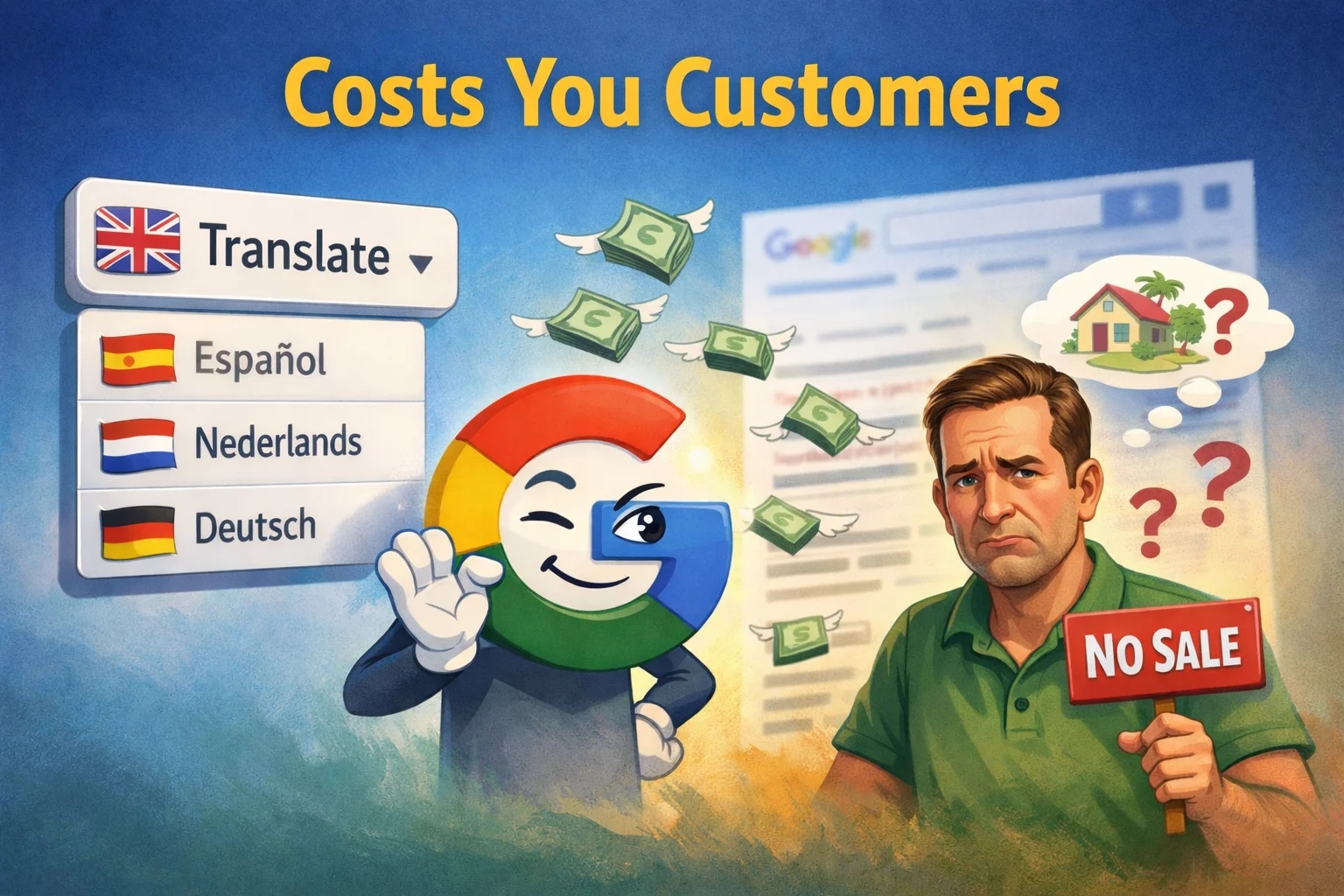

Many websites that want to reach international audiences choose what seems like a simple solution: a language button. One click, another language, done. It looks efficient. In reality, it is one of the most common reasons multilingual websites fail to perform.
A language button does not make your website multilingual. It only makes it look that way.
What a language button actually does
A translation widget, such as Google Translate, only translates the website inside the visitor’s browser. No real language pages are created and nothing changes in the site structure.
For Google, this means:
- the website technically exists in only one language
- translated text is not indexed
- there are no separate URLs per language
- SEO titles and descriptions per language are impossible
- the website cannot rank in other languages
To users the site appears multilingual. To search engines, it is not.
Why this directly harms your SEO
SEO works per page and per language. To rank in English, Dutch or Spanish, Google needs separate pages with their own content and SEO signals.
With a language button, all of that is missing:
- no keywords per language
- no control over search intent
- no internal linking per language
- no authority per language
As a result, your website remains visible only in its original language. Other languages generate little to no organic traffic.
Automatic translations damage trust
Beyond SEO, there is a trust issue. Translation widgets almost always produce literal, unnatural translations. Industry terms are incorrect, sentences feel awkward and the tone is off.
Visitors notice this immediately, even if they cannot explain why. This leads to:
- reduced trust
- fewer enquiries
- higher bounce rates
- lower conversion rates
For high-involvement services such as real estate or professional services, language plays a critical role in decision-making.
Why language buttons are still popular
Language buttons are chosen not because they work, but because they are:
- fast
- cheap
- visually convincing
But SEO and conversions do not work on appearance. They rely on structure, content and intent. On all three, language buttons fail.
What actually works for multilingual websites
Websites that generate real results in multiple languages are built with intention:
- separate pages per language
- clear URL structures (such as /en/, /nl/, /es/)
- unique content per language
- individual SEO titles and descriptions
- correct hreflang implementation
In my own work using Sanity CMS, I structure websites this way deliberately. Each language is treated as a full version of the site, with its own content and SEO configuration. This is the only way to build visibility and trust per language.
Conclusion
A language button may look convenient, but it costs you visibility, credibility and customers. Google cannot index it and users do not trust it.
If you want a multilingual website that actually works, quality and structure per language are essential. Anything less is a shortcut that backfires.