Every day, people on the Costa Blanca search for properties and agents online. Most real estate websites lose those visitors due to the same 5 avoidable mistakes. Here's what they are.
5 mistakes on real estate websites and how to fix them
Every day, people on the Costa Blanca search for properties on their phones. Dutch buyers looking for a holiday villa near Altea. British retirees researching sea-view apartments around Calpe. Belgian families looking for a reputable agent before they fly out.
Most real estate websites lose those visitors due to the same handful of avoidable mistakes. Here's what they are.
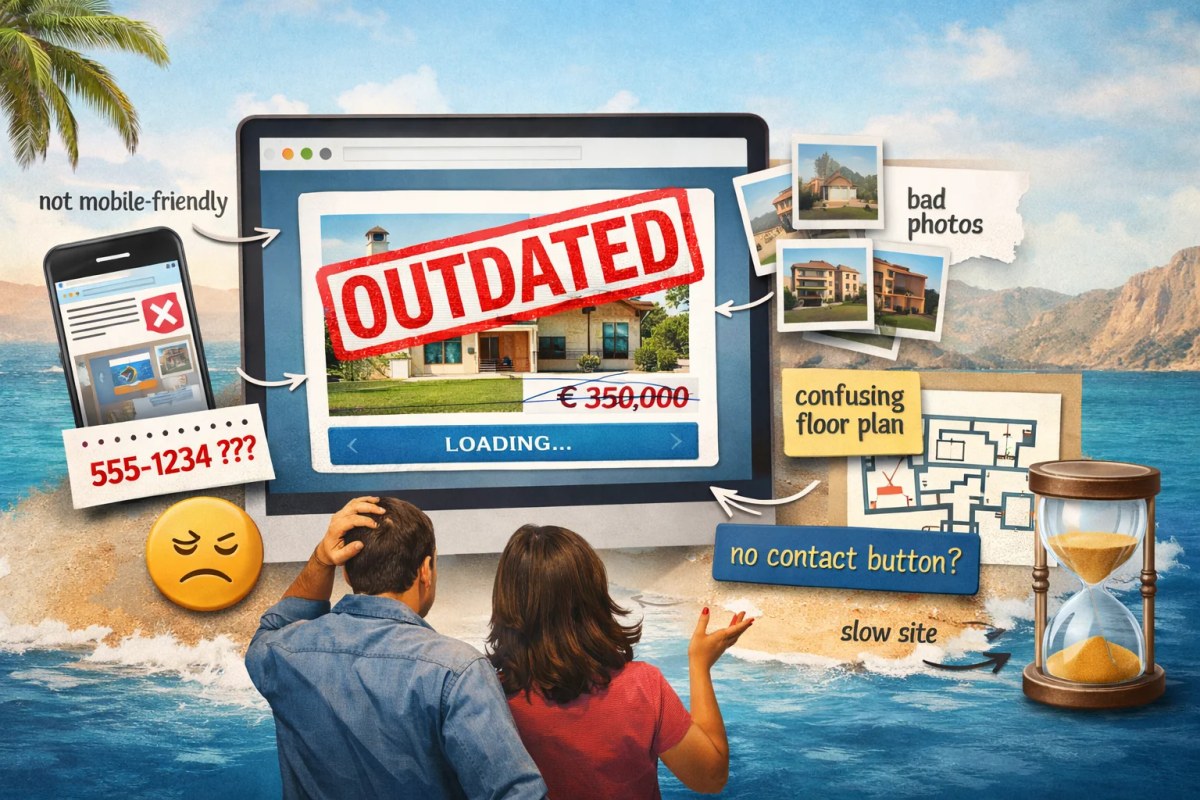
1. No mobile-friendly design
Mobile matters for property websites because many buyers search on their phones while travelling or researching from abroad. Your own analytics will show the actual mobile share for your agency; do not rely on a generic percentage.
A site that works well on desktop but is awkward on mobile makes property search and contact harder. Small text, cropped photos, difficult filters or hard-to-tap controls can damage both trust and conversion.
Fix: Test every page on a real phone. Not a browser with a narrowed window, an actual mobile device. Check that text is readable, images scale correctly, and every button is easy to tap. If anything requires zooming or sideways scrolling, it needs fixing before anything else.
2. Outdated property listings
A property listed as available that was sold 3 months ago, a price that no longer reflects the market, photos from 2019 before the renovation: all of these do the same thing. They tell the visitor that this website isn't maintained, and by extension, that this agency might not be either.
Buyers on the Costa Blanca do serious research. They screenshot listings, compare agencies, and come back multiple times before making contact. An outdated listing discovered on the third visit can undo the trust built across the first two.
Fix: Update property status, price and availability as quickly as your own process and CRM allow. There is no universal 48-hour rule; the goal is to avoid systematically outdated information and clearly mark sold or reserved properties.
3. Poor quality photos
Property photos are often the first thing a buyer looks at, sometimes before they read the address. Blurry images, dark rooms, photos taken from an awkward angle: they make a good property look worse than it is and an average property look bad.
For international buyers, photos are especially important because much of the initial selection happens online. Good imagery helps buyers assess a property accurately before arranging a viewing.
Fix: Professional photography can add significant value, but it is not mandatory for every property or agency. At minimum, use sharp, well-lit, representative images with consistent framing and enough coverage to show the property honestly.
4. No clear contact information on every page
A buyer who wants to ask a question about a specific listing shouldn't have to find a contact page in the menu, load it, and fill in a form. They should be able to call, WhatsApp, or email from anywhere on the site without thinking about it.
Make contact options clear on property detail pages and other relevant locations. That may be phone, WhatsApp, email or a form. Fast responses are commercially useful, but there is no universal rule that every enquiry must be answered within a few hours.
On the Costa Blanca, WhatsApp is how a lot of initial enquiries happen. A direct WhatsApp link on the listing itself makes that first message easy to send.
Fix: Give every property detail page a clear way to enquire about that specific listing. Use WhatsApp when it fits the audience, while keeping other contact routes available where customers need them.
5. A site that loads too slowly
A slow real estate site can make property search frustrating and cause visitors to leave. Performance and Core Web Vitals can also contribute to page experience, but speed alone does not determine Google ranking.
Property websites often handle large photo sets, filters, CRM data and maps. That can become heavy when assets, API calls and scripts are poorly optimised. Measure the real property-search and detail pages rather than relying on one fixed load-time threshold.
Fix: Optimise property images, caching, API requests and the components that demonstrably cause delay. WordPress, Next.js with CRM integration or another stack can work well when implemented appropriately. Choose technology based on management, integration, performance and required flexibility.
The Costa Blanca angle most agencies miss
Beyond these five points, multilingual content matters for many Costa Blanca agencies because they serve international buyers. The right languages depend on the agency and its actual client base.
Dutch, British, Belgian, German and other international buyers may search in different languages. A strong multilingual structure gives each relevant language its own crawlable URL and suitable content, but a single-language site is not automatically invisible to everyone searching in another language.
A translation widget without separate URLs does not solve multilingual SEO. Automatic translation can still be part of a good workflow when translated pages are published as genuine crawlable URLs and reviewed for quality. What works is a properly built multilingual site with strong content, separate language URLs and hreflang where appropriate.
These mistakes cost real estate agencies on the Costa Blanca real clients, every day. Most are fixable without rebuilding from scratch.
If you want to know which of these is affecting your agency site, send me your URL on WhatsApp and I'll give you an honest assessment.
Read more: