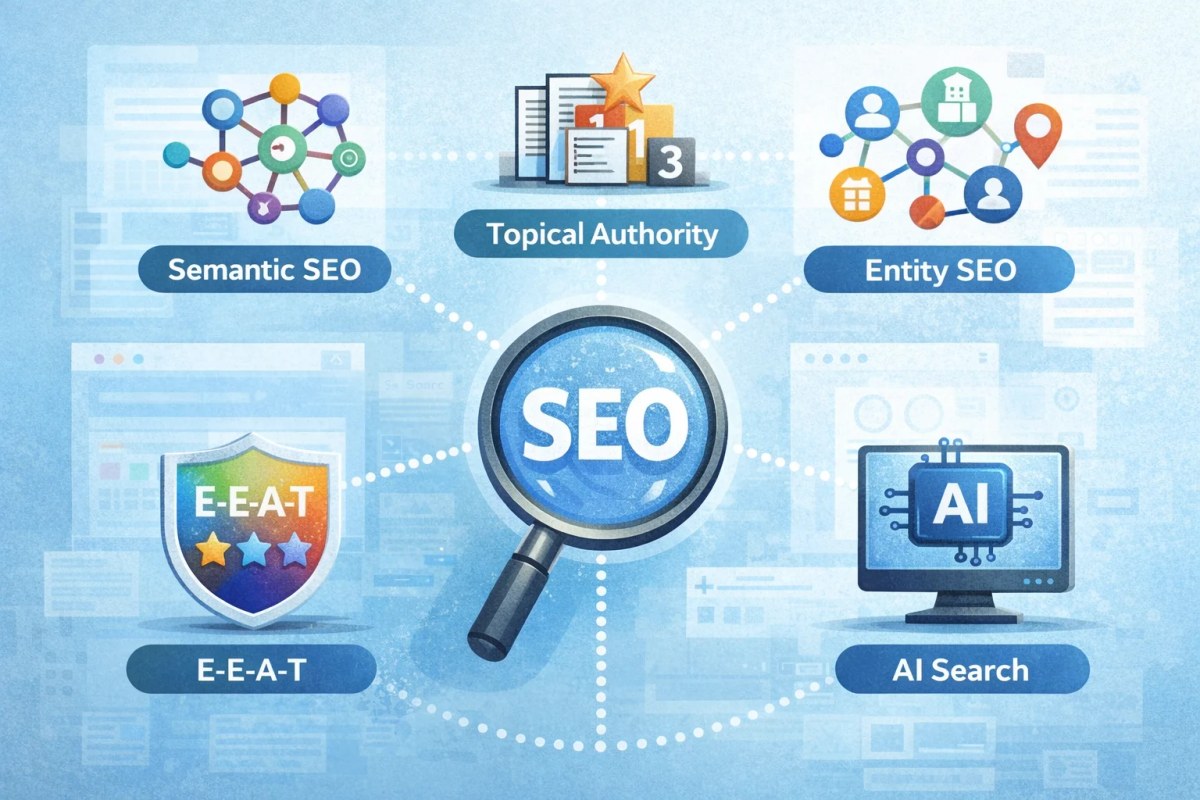
Semantic SEO. Topical authority. E-E-A-T. These terms show up everywhere now. Here's what they actually mean in plain language, and why they matter specifically for businesses on the Costa Blanca.
SEO terminology: modern SEO concepts explained
If you read about SEO today you'll quickly encounter terms that didn't exist 5 years ago. Semantic SEO. Topical authority. Entity SEO. E-E-A-T. AI search.
Most explanations of these terms are written for other SEO professionals. This one is written for business owners on the Costa Blanca who want to understand what they mean and why they matter.
Start with what SEO is and how search engines work if you haven't already. This article builds on that.
Semantic search
Old SEO was about exact keywords. You wanted to rank for "web designer Altea," so you put "web designer Altea" on your page as many times as possible.
Google has moved well past that. It now tries to understand the meaning behind a search query, not just the words in it.
Someone searching "how do I find a reliable builder in Spain" and someone searching "construction company Costa Blanca" are looking for essentially the same thing. Google knows that. A page about builders on the Costa Blanca can now rank for both searches without containing the exact phrase from either.
Semantic SEO is simply the practice of writing content that covers a topic thoroughly and clearly, so Google can understand the full context rather than just matching keywords. The SearchEngineLand guide to semantic SEO covers this in depth if you want to go further.
For your business: write about your services in natural language, covering all the related questions and concepts a client would have. Stop trying to repeat exact phrases and start trying to fully answer the question.
Topical authority
Imagine 2 local websites. One has a single page about real estate on the Costa Blanca. The other has 20 well-written articles covering every aspect of buying property in Spain: the legal process, the costs, the regions, what to watch out for, how to choose an agent.
The second site has more opportunities to answer different questions well and make relationships between topics clear. SEO professionals often call that accumulated thematic coverage topical authority. Google does not publish a separate topical-authority score.
For Costa Blanca businesses, deeper useful content can be an advantage when competitors provide little useful information. Do not publish to hit an article count; publish because you can answer genuine questions better with local and professional knowledge.
New articles do not automatically strengthen every other page. They help when they are genuinely useful, logically connected and add something meaningful within the same subject.
Entity-based SEO
Entities are the specific things Google has mapped in its knowledge base: people, places, businesses, concepts. Google doesn't just read text; it maps relationships between these entities.
A web design agency based in La Nucia that works with real estate businesses in Calpe, Altea, and Javea is a specific entity with specific relationships to specific places and sectors. The more clearly your content establishes those connections, the better Google understands what your business is and who it serves.
In practice: name the places you work. Name the types of clients you serve. Name the specific problems you solve. Be specific rather than general. "Web designer" is a generic term. "Web designer who builds multilingual real estate websites for Dutch and British buyers on the Costa Blanca" is an entity with context.
E-E-A-T
E-E-A-T stands for Experience, Expertise, Authoritativeness and Trustworthiness. The term comes from Google's Search Quality Rater Guidelines. It is not a standalone ranking factor or score, but a framework used to assess quality and trust.
The 4 parts work together. Experience means you've done this, not just read about it. Expertise means you know it deeply. Authoritativeness means others in your field recognise you. Trustworthiness means your site, your content, and your claims check out.
For local Costa Blanca businesses, specificity helps make experience and expertise visible. An estate agent in Moraira can explain real questions and situations from years of helping buyers. That makes content more concrete and verifiable without implying a fixed E-E-A-T score.
You already have the experience. The content just needs to reflect it.
AI search and why SEO fundamentals still apply
AI search experiences such as Google AI Overviews and ChatGPT Search use information from the web. A strong SEO foundation helps because pages are easier to find, crawl and understand. Sources in AI answers are not simply the same set as the highest traditional search results.
A 2025 study found substantial overlap at that time between ChatGPT citations and Bing results, but that is not a fixed 2026 ranking rule. Platforms, search sources and models change. Focus on useful, reliable content and sound technical SEO rather than one supposed AI signal.
The full picture of how AI search is changing visibility on the Costa Blanca is in the GEO guide.
How this all connects
These concepts aren't separate tools. They're different ways of describing the same underlying principle: Google wants to send searchers to the most trustworthy, most relevant, most useful source for their question.
A business that covers its subject well, clearly connects services and locations, uses natural language and demonstrates real expertise builds a stronger SEO foundation. None of these concepts individually guarantees rankings.
For practical application, the guide to writing content for SEO and AI search covers exactly how to do this.
Send me your URL on WhatsApp if you want a direct assessment of how your current content stacks up.
Read more: