Your website gets visitors. But nobody calls. Nobody fills in the form. Nobody enquires. Here are the 5 most common reasons that happens, and what to do about each one.
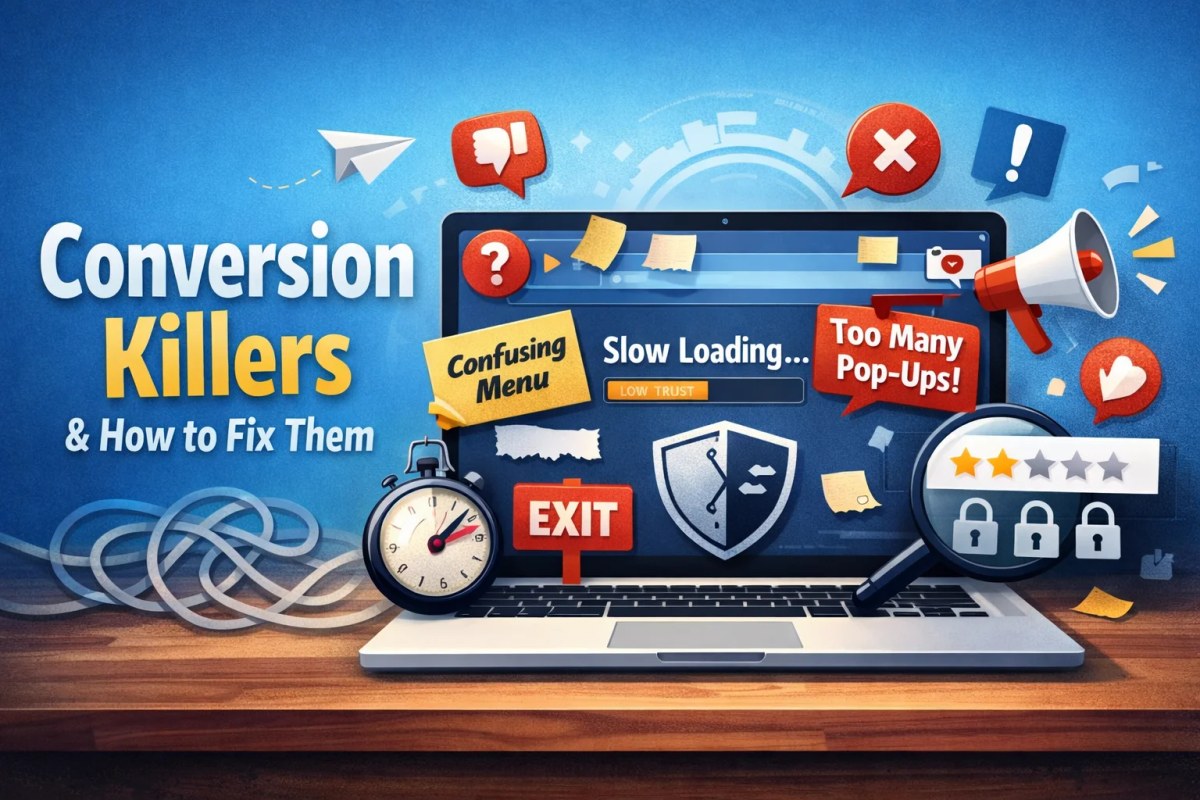
5 conversion killers on your website and how to fix them
Traffic isn't the problem. Most business websites on the Costa Blanca get some visitors. The problem is that those visitors leave without doing anything.
No call. No email. No enquiry. Just a visit, a few seconds, and a back button.
Here are the 5 most common reasons that happens.
1. The page loads too slowly
Slow loading can hurt conversion. Research by Portent shows a clear relationship in their dataset between faster load times and higher conversion. That is not a universal three-second rule; use it as a reason to measure the actual performance of your own site.
Slow sites can have many causes: large images, scripts, server response time, external embeds, inefficient code or plugins. Plugin count or hosting price alone does not tell you enough.
Fix: Optimise the components that are actually slowing the site down. Compress images, measure scripts and server response, and review WordPress plugins for necessity and impact. A different technology such as Next.js may be appropriate, but it is not automatically faster than a well-built WordPress site.
2. There's no clear call to action
If a visitor doesn't know what to do next, they do nothing.
A lot of websites have contact details buried in the footer, a contact page in the menu that nobody clicks, and nothing on the homepage that tells a visitor to take action. The business owner sees a complete website. The visitor sees a page with no obvious next step.
Fix: Give important pages a clear next step when one makes sense. That might be a button, phone number, WhatsApp link, booking action or internal link. 'Above the fold' is not a universal requirement; place the action where the visitor has enough context to continue.
3. The content talks about you instead of the visitor
"We have been in business since 2003." "We are a family-run company." "We are passionate about quality."
None of that answers the question a visitor actually has: can you solve my problem?
Content should feel relevant quickly. That does not mean every page must open with the visitor's problem. A clear service, outcome, audience or question can work just as well as long as the relevance is obvious.
Fix: Make it clear early what you do for the visitor, then use your experience, history and credentials as proof. The best order depends on the page and the type of decision being made.
4. The site doesn't work properly on mobile
Mobile traffic represents a large share for many websites. Check your own analytics to see how important mobile is for your audience and test the mobile experience as carefully as desktop.
A site that works on desktop but is awkward on mobile can frustrate visitors and reduce conversion. Common issues include small text, misaligned buttons, overflowing images and navigation that does not work properly.
Fix: Test your site on an actual phone, not just a browser resize. Tap every button. Read every paragraph. If anything is hard to use or read, it needs fixing before anything else.
5. There are no trust signals
A visitor who doesn't know you has no reason to trust you yet. Trust signals are the things that bridge that gap: proof that other people have hired you and were glad they did.
Testimonials. Reviews. Case studies. A photo of you or your team. Logos of companies you've worked with. Even something as simple as your full address and phone number (not just a contact form) signals that a real business operates here.
On the Costa Blanca specifically, where many clients are international and can't easily verify who they're dealing with, trust signals carry extra weight.
Fix: Add relevant trust signals you can genuinely support: reviews, case studies, photos of the people behind the business, clear contact details or industry information. There is no magic minimum of three testimonials; quality and credibility matter more than quantity.
These five issues are common on websites that receive visitors but generate few enquiries. Which factor matters most on your site needs to be measured and assessed; there is no fixed distribution that applies to every website.
If you want to know which of these is hurting your site most, send me your URL on WhatsApp and I'll take a look.
Read more: