Anyone on the Costa Blanca searching for 'restaurant Calpe' or 'best paella Altea' first sees a map with a few restaurants. More and more guests ask the same question to ChatGPT, Perplexity or Google's AI overview. In both cases, the winner is not necessarily the best restaurant, but the restaurant whose information is clearest and most consistent online.
You do not need a big marketing budget for this. You need three things that work together: a complete Google Business Profile, your own website with clear information, and reviews.
How does Google decide which restaurants appear in Maps?
Google looks at three things: how well you match the search (relevance), how close you are (distance) and how well known and well rated you are (prominence). You cannot change distance. You can change relevance and prominence, and that is what the rest of this article is about.
What should you fill in on your Google Business Profile?
Everything you can. Choose the most specific primary category, for example 'Mediterranean restaurant' or 'Pizzeria' instead of just 'Restaurant'. Add your opening hours, including special hours around holidays. Add your menu or a link to it, recent photos, a booking link and attributes such as terrace, vegetarian options or wheelchair access. Link to your own website, not your Instagram.
For a detailed explanation, read Google Business Profile: the free tool most Costa Blanca businesses use wrong.
Why does your restaurant also need its own website for local SEO?
Your Business Profile and your website reinforce each other. When your website shows the same name, address and phone number as your profile, it is clearer to Google that the information is correct. Your website also gives you room for everything a profile cannot hold: your full menu, your story, events and pages in several languages.
What is Restaurant schema and why does it help?
Restaurant schema is a piece of code in your website that tells search engines: this is a restaurant, with this name, this address, this cuisine, this price range and these opening hours. Visitors do not see it, but Google and AI systems read it. It makes your information unambiguous, so there is less guesswork.
How do you get mentioned by ChatGPT, Perplexity and Google AI?
AI assistants build their answers from information they find online: websites, Google Maps, review sites and articles. They are more likely to mention a restaurant when its information is clear, up to date and consistent across several places. Optimising for this is called GEO, generative engine optimization.
What helps: describe in plain text what you serve and where you are, for example 'Italian wood-fired pizzeria in the centre of Benidorm'. Answer the questions guests actually ask: do you have gluten-free options, can you take groups, is there parking? And make sure your menu can be read as text.
For more background, read GEO and SEO in 2026: visibility in Google AI.
Can a PDF menu cost you visibility?
Yes, if it is your only menu. A scanned PDF or a menu saved as an image is often hard or impossible for search engines to read. If someone searches for 'restaurant with gluten-free pizza Calpe', Google can only connect your gluten-free pizza to that search if it appears somewhere as text. So put at least your main dishes on your website as text and use the PDF as an extra.
How important are reviews for restaurants?
Very important, for Google and for guests. Actively ask happy guests for a review, for example with a QR code on the bill or table card. Reply to reviews, including negative ones, calmly and in the guest's language. It shows your restaurant is active and that you care about your guests.
Focus mainly on Google reviews. TripAdvisor and TheFork matter for your reputation, but for your position in Google Maps your Google reviews matter most.
Local visibility in multiple languages
A Dutch visitor in Jávea searches in Dutch, a British visitor in English and a Spanish guest in Spanish. With separate translated pages per language, each with its own title and description, you can be found in all of those languages. An automatic translation button does not do that. Also read why your Costa Blanca business needs a multilingual website.
Checklist: local SEO for your restaurant
- Complete Google Business Profile with the right primary category
- Name, address and phone number exactly the same everywhere
- Your own website, linked from your Business Profile
- Restaurant schema on your website
- Menu (at least the main dishes) as text
- Up-to-date opening hours, including holidays and the winter season
- A steady flow of new Google reviews, with replies
- Translated pages in your guests' languages
Want to know what else belongs on your website? See the checklist for a good restaurant website.
A restaurant website with all of this built in
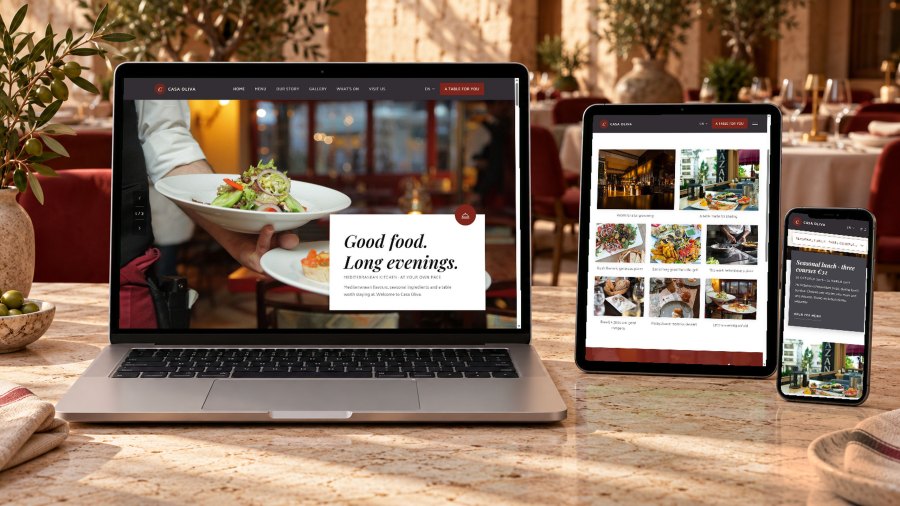
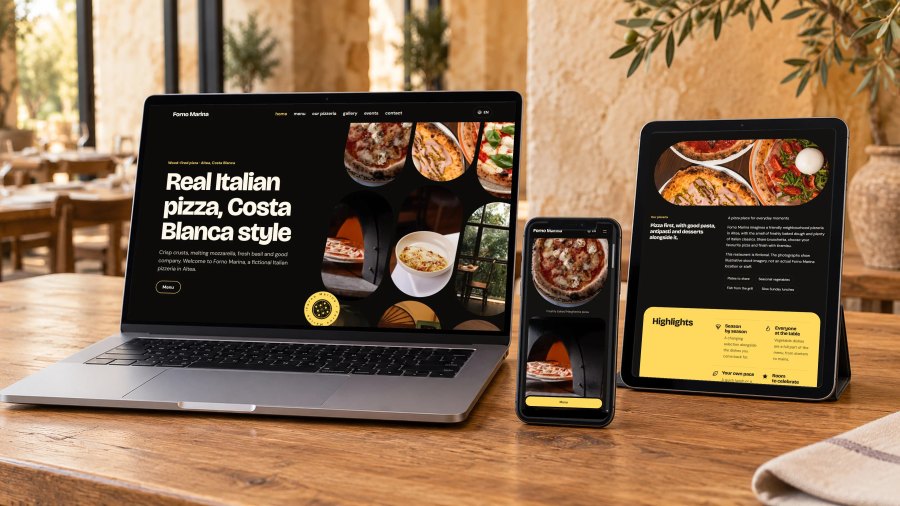
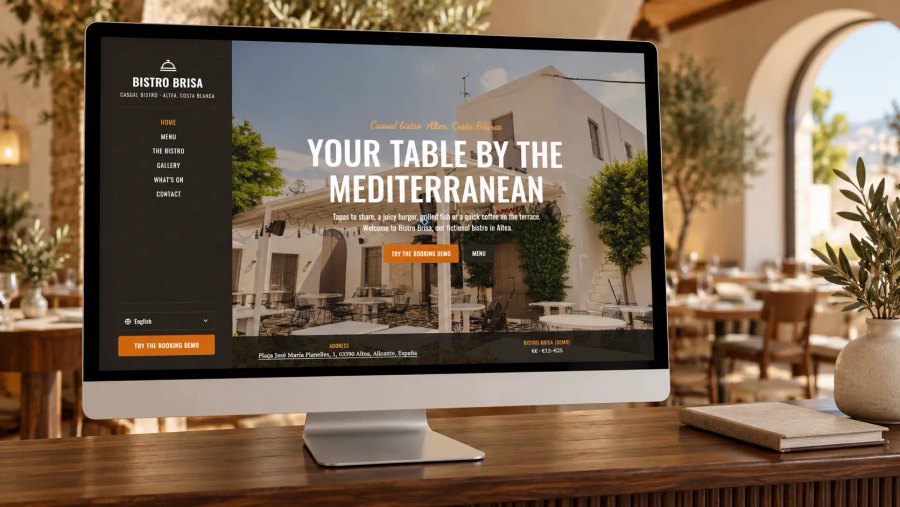
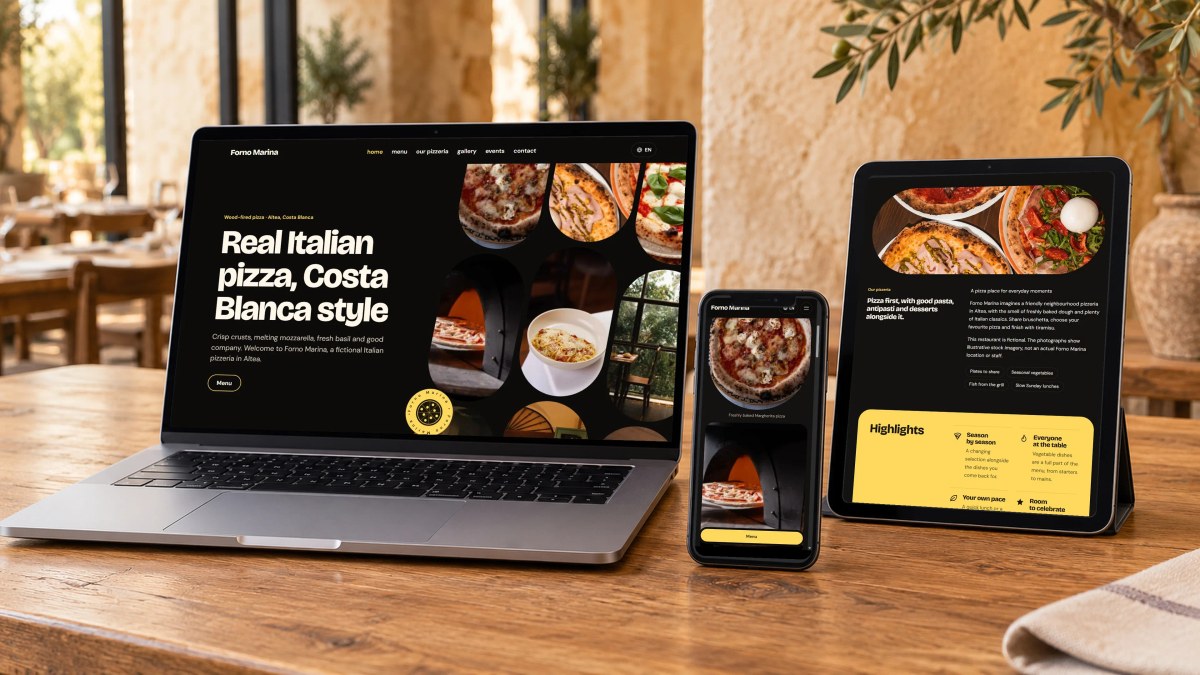
My restaurant websites for the Costa Blanca include Restaurant schema, a separate title and description per page and language, and an online menu alongside the PDF as standard. A pizzeria might choose Forno Marina, for example. All you still need to do is link your Google Business Profile. Nobody can guarantee a top position, but the technical foundations are in place.
Frequently asked questions
How long does it take before my restaurant appears in Google Maps?
A new Business Profile must be verified first. After that you usually appear within a few days to a few weeks. A higher position comes with time, reviews and consistent information on your profile and your website.
Can I pay to be mentioned by ChatGPT?
You cannot buy a regular mention in an AI answer. AI assistants use public information, so clear, current and consistent information on your website and Business Profile is the way to improve your chances.
Is my Instagram enough for local SEO?
No. Instagram helps with visibility and atmosphere, but Google mainly uses your Business Profile and your website. Also read why your own restaurant website alongside TheFork and Instagram pays off.