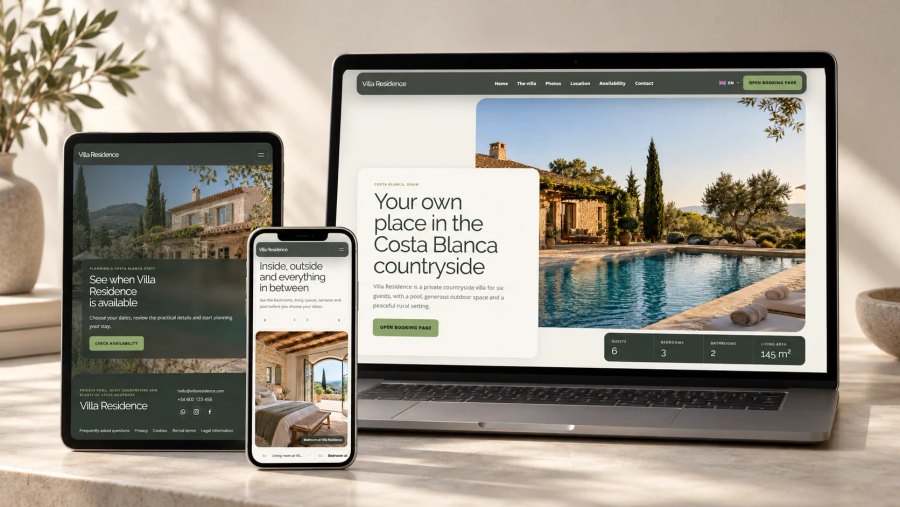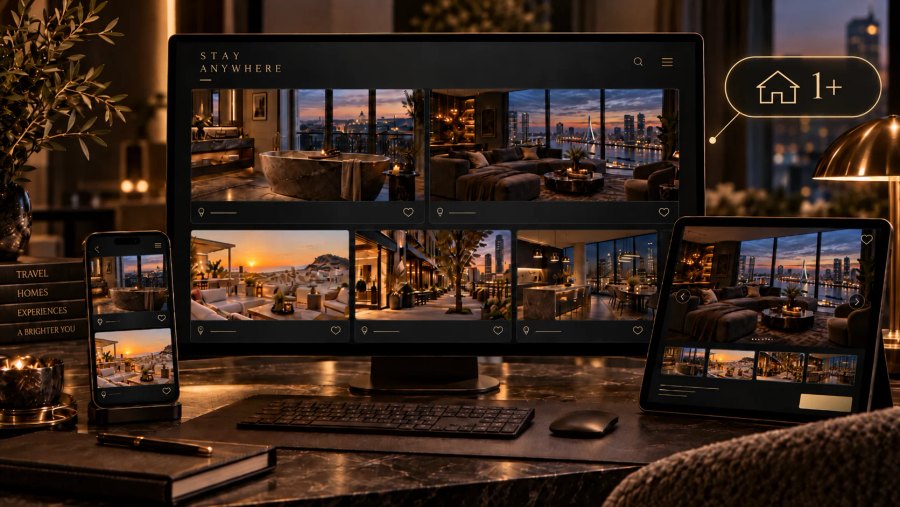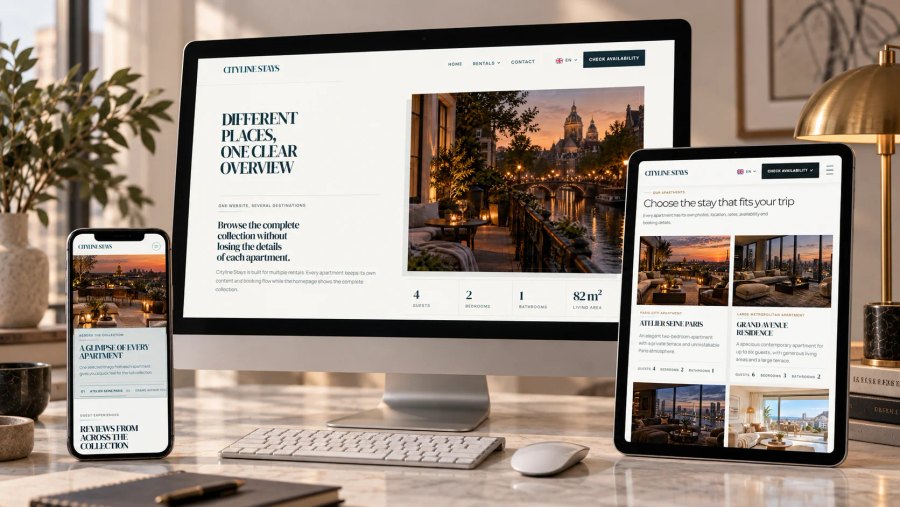
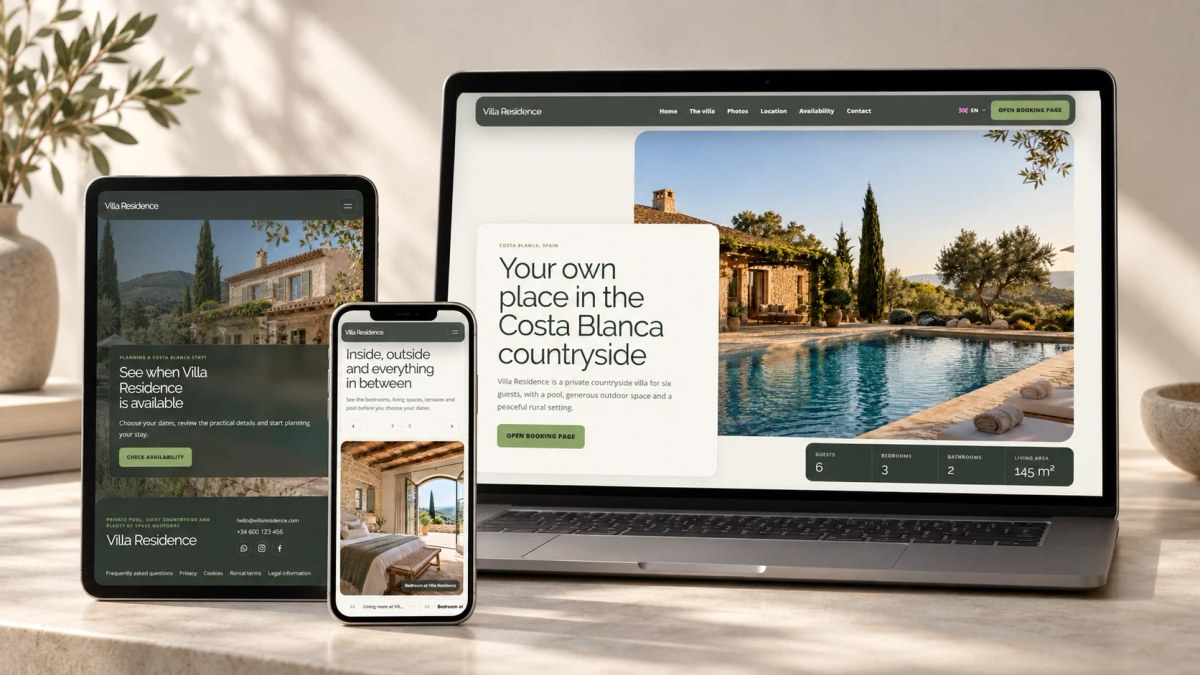
A good vacation rental website needs to do more than show attractive photos. Guests want to decide quickly whether the property fits their trip, where it is located, what is included, when it is available and how the booking process works.
The strongest structure combines atmosphere with concrete information. Large photography gets attention, while clear property details, location, amenities, reviews and availability help the guest make a decision.
What should appear at the top of a vacation rental website?
The top of the page should immediately explain what you rent and where it is. A title such as 'Villa with private pool in Altea' gives more useful context than only a property name. Combine it with a strong image or video and a clear action such as checking availability or making contact.
How many photos does a vacation rental website need?
There is no fixed number that works for every property. What matters is giving a complete visual impression. Do not show only the pool or view. Include bedrooms, bathrooms, kitchen, living room, outdoor areas, entrance and relevant details.
A central photo and video library makes it easier to reuse the same media consistently across the website. The homepage can show a selected preview while the full gallery presents every part of the accommodation.
Which property details should guests find quickly?
Capacity, bedrooms, beds, bathrooms and important amenities should be easy to scan. Depending on the property, this can also include Wi-Fi, air conditioning, pool, parking, washing machine, kitchen, lift, terrace, barbecue, pets or accessibility.
Do not hide simple factual information inside long paragraphs. A guest should not have to read three sections to find out whether the property has air conditioning.
How important is the location?
Very important. With vacation rentals, guests choose both the property and the destination. Explain the town and area and include relevant distances such as beach, centre, restaurants, supermarket, airport or public transport. For properties in places such as Benidorm, Altea, Jávea/Xàbia or San Fulgencio, that local information can be an important part of the decision.
Concrete location information is also useful for local SEO and AI discoverability. A page that clearly states that an apartment in Benidorm is within walking distance of the beach, or that a villa near Altea or Finestrat is close to specific amenities, gives search engines and AI systems more context than generic copy about 'a perfect Costa Blanca location'.
Should reviews appear on your own vacation rental website?
Reviews help visitors understand how previous guests experienced the property. Use genuine reviews and make the source clear when relevant. A smaller selection of useful reviews is more informative than a long row of stars without context.
How should availability and booking be presented?
The website should make the next step obvious. This can be an enquiry form, external booking widget, calendar or integration with rental management software. The right setup depends on the booking workflow you already use.
With a PMS integration, data such as availability, rates, reservations and property information may be used from the rental software, depending on the platform and API. For a simpler website, an external calendar or booking widget may already be enough.
For the technical options, also read Connect a PMS to your vacation rental website.
What role do house rules and FAQs play?
House rules prevent uncertainty before and after booking. This may include check-in and check-out, smoking, pets, parties, parking and rules for a pool or apartment complex. An FAQ can answer recurring questions about children, access, deposits, amenities and arrival information.
Clear question-and-answer structures are also useful for search engines and AI systems because specific topics are stated explicitly.
Why are multiple languages important for vacation rentals?
Vacation rentals often attract international guests. A multilingual website makes the content easier to understand and provides room for clear pages and metadata in each active language.
Costa Wave Web's standard vacation rental websites include up to three active languages. Additional languages are available at extra cost.
Should you be able to update the website yourself?
Yes. Photos, copy, property details, amenities and other current information change over time. A CMS allows you to keep that content up to date without rebuilding the website for every text change.
What makes a vacation rental website easier for Google and AI to understand?
The foundation is clear, factual and well-structured content. State the property type, real location, capacity, amenities and surrounding area. Use logical page titles and headings and make important information available as text, not only inside images.
For GEO and AI discoverability, it also helps to answer the questions guests actually ask. Examples include 'Is parking available?', 'How far is the beach?' and 'Can I check availability online?'. This makes the information easier to interpret.
No structure guarantees a Google position or a mention by an AI assistant. It does make the subject of the website and the information belonging to the accommodation much clearer.
What does a complete vacation rental website look like in practice?
A strong foundation includes a clear hero, property introduction, photos and video, bedrooms, amenities, reviews, host information, location and surroundings, availability or booking, house rules, FAQ and contact. For multiple rentals, add a property overview and separate detail pages.
These elements do not need to be crowded together. Good UX means distributing information logically and keeping it just as usable on mobile as on desktop.
View the different vacation rental website designs and live demos.