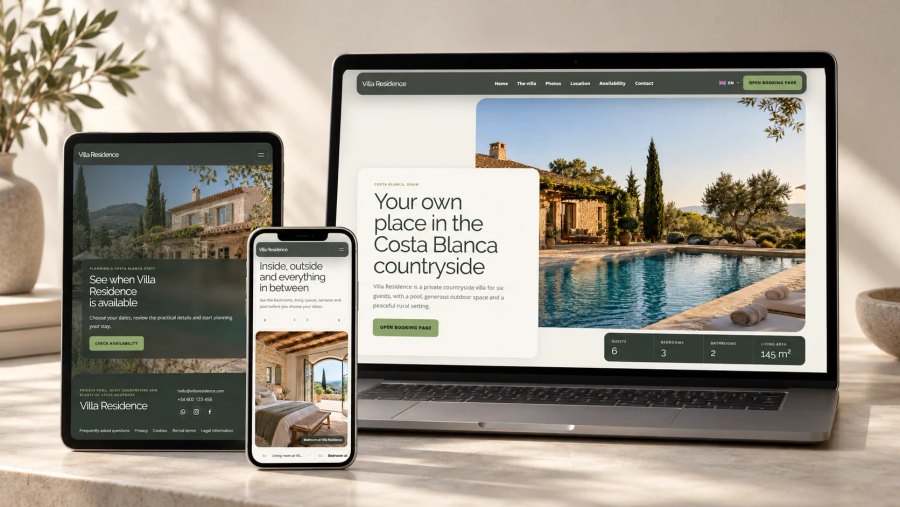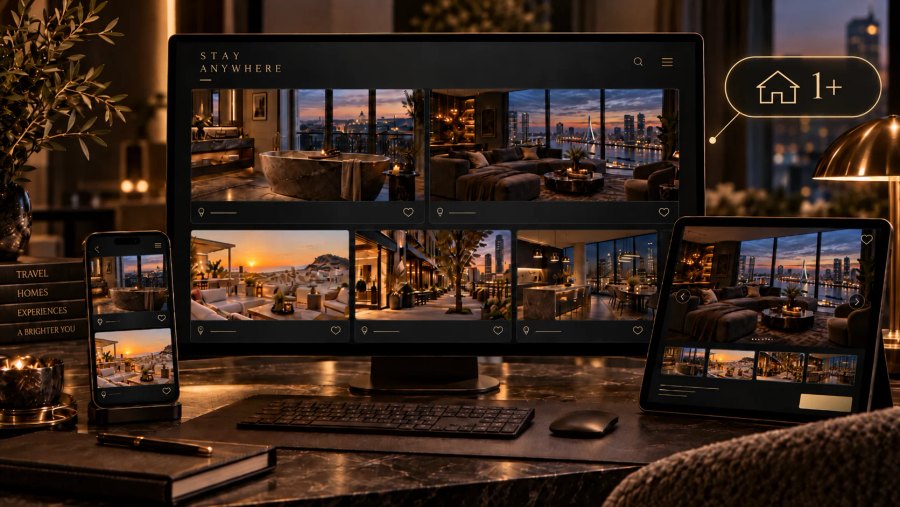
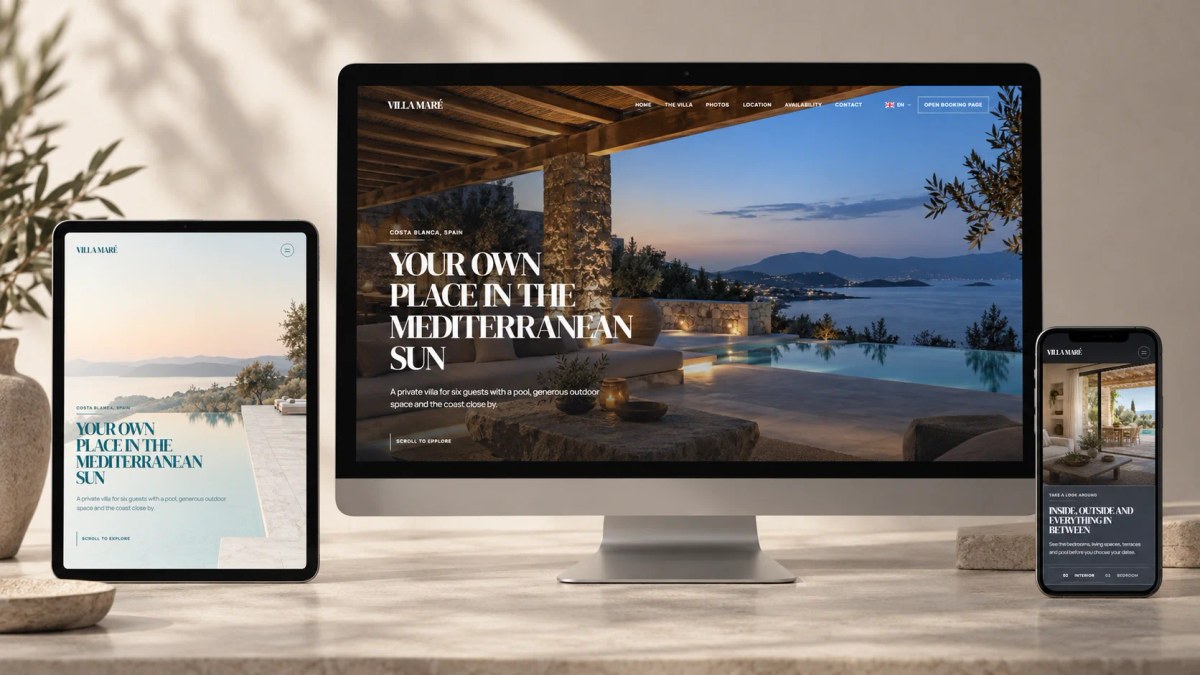
Airbnb and Booking.com can provide substantial reach for a vacation rental. Your own website does not automatically replace those platforms, but it adds something a marketplace listing cannot provide: a dedicated place where you control how the property, the surroundings and the booking route are presented.
For many owners and property managers, the combination works well. Guests may first discover a property through a marketplace and later search for its own website. Returning guests can find the property again directly. People searching through Google or an AI assistant for a villa, holiday home or apartment in a specific destination can also reach the property's own website.
What is the difference between your own website and Airbnb or Booking.com?
A rental platform is primarily a marketplace. It brings many accommodations together, provides filters and handles much of the booking journey within its own environment. A vacation rental website is focused entirely on your property or your own rental portfolio.
On your own site you decide which photos get the most attention, what information guests see first, how the location is described and which languages are available. You are not limited to a platform's fixed listing layout. This is particularly useful for properties with a distinct identity, such as a villa in Altea, an apartment in Benidorm, a rural home or a collection of multiple rentals.
Why use your own website alongside rental platforms?
The main benefit is having one central place for your own rental offer. You can explain what makes the property different, add practical information and give guests a much stronger sense of the accommodation. Large photo galleries, video, bedrooms, amenities, house rules, reviews, directions and local information can all be presented in a clear structure.
Your own domain also improves recognition. When someone searches for the name of your property or rental business, an official website gives them a clear source. It also gives you more control over the information search engines and AI systems can find and understand about the accommodation.
You can also choose a booking route that fits the way you work. This may be an enquiry form, a link to your existing booking system, an availability calendar or booking widget, or a more extensive integration with rental management software.
How can guests book through your own vacation rental website?
There are several options. For a straightforward rental website, an availability calendar or external booking widget may be enough. Guests can check availability on your website and continue to the booking environment you already use.
If you use a PMS or vacation rental management system, the website can often be connected more extensively. Depending on the software and available API, availability, rates, reservations and property data can be exchanged so the website becomes part of the same rental workflow.
Read more in Connect a PMS to your vacation rental website.
What should your own rental website make clear?
A guest wants quick answers to practical questions: what am I renting, where is it, how many people can stay, what amenities are included, what does the property look like, when is it available and how do I book or get in touch? If this information is scattered or unclear, the booking journey becomes harder.
A clear structure therefore works better than a site that focuses only on decoration. Strong vacation rental websites combine good photography with factual property information such as bedrooms and beds, bathrooms, air conditioning, pool, parking, Wi-Fi, distance to the beach or town centre, check-in and check-out, house rules and FAQs.
Can one website show multiple vacation rentals?
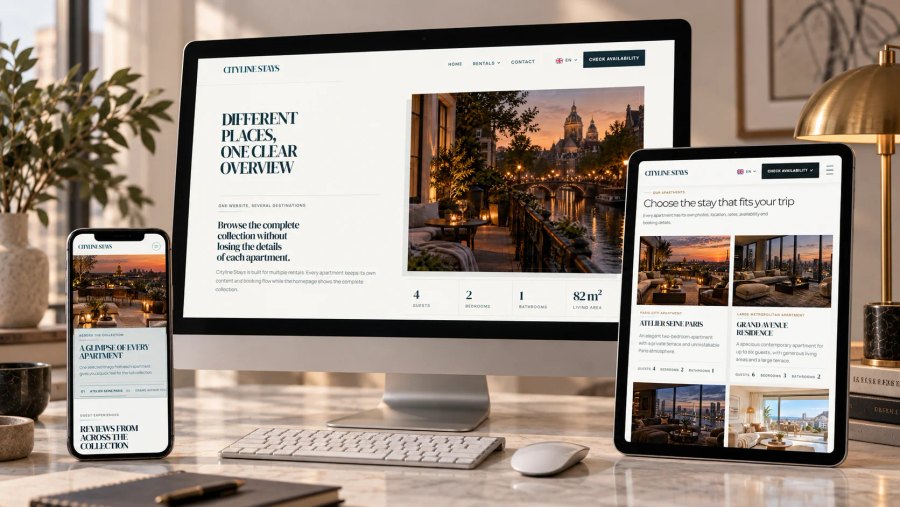
Yes. For multiple properties, one scalable website is usually more practical than separate sites. You can use one main domain with a property overview and a dedicated detail page for every rental. New properties can then be added later within the same structure.
Also read: Website for multiple vacation rentals.
How can your own website support Google and AI discoverability?
Your own site gives you space to describe the property more specifically than a generic listing. You can clearly state the property type, location and region, the kind of guests it suits and the features that matter. For a villa in Altea, an apartment in Benidorm or a holiday home in Finestrat, the real location and surrounding area become part of the content. This context helps search engines and AI systems understand what you offer.
That does not mean a website will automatically rank at the top of Google or be mentioned by ChatGPT. It does give you an owned source with structured and current information, which is a stronger foundation than relying only on a profile hosted by another platform.
When is your own vacation rental website useful?
A dedicated website becomes especially useful when you want to present the accommodation professionally, give returning guests a direct place to find you, offer multiple languages, manage several rentals or connect the booking journey to existing rental software.
For one property, this does not need to be complicated. A fixed vacation rental website can already bring photos, property information, local details, availability and contact together in one professional place.
At Costa Wave Web, a standard vacation rental website based on an existing design starts at €325 and includes up to three active languages. Without a PMS integration, the standard delivery time is 5 working days after all required content has been supplied.
View the available vacation rental website designs.